
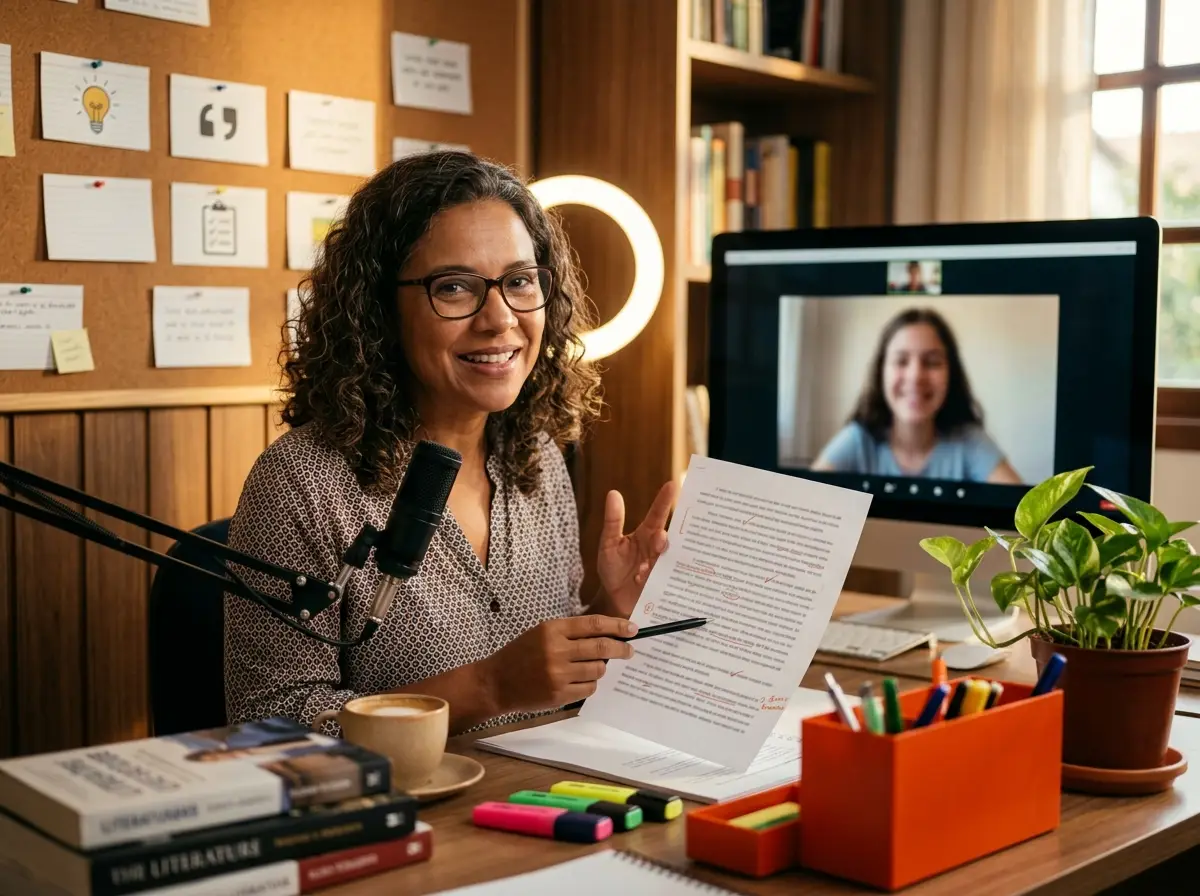
How to teach online classes: planning, pricing and tips
Learn how to teach online classes: what you need, how much to charge, live and recorded formats, how to attract students and how to turn your lessons into a digital product.

What will we see in this post

Teaching online private lessons means teaching specific content to one student or a group over the internet and getting paid for it. It is not limited to live tutoring: it also includes recorded courses, mentoring and communities, formats that let you teach many people without repeating the same lesson from scratch every time.
Learning at a distance is no longer the exception. In the European Union, 33% of internet users took an online course or used online learning materials in 2024, up from 30% in 2023, according to Eurostat. In other words, learning online has become a habit, and that opens space for anyone who wants to teach.
If you are a teacher or an expert in a subject and want extra income, or even your main income, this guide shows you the step-by-step, how much to charge, how to make money with your classes and which platform to use. Let’s get to it.
What do you need to become a private tutor?
To teach private lessons online, you need three things: subject expertise, a simple work setup and teaching skills. A degree helps in some fields, but it is not mandatory. What really matters is knowing your subject well and being able to explain it.
You do not need professional equipment to start. A suitable computer or phone, a stable internet connection, a microphone with clear audio and a quiet space can be enough for your first lessons.
Beyond the technical setup, a few skills make a difference:
- Subject knowledge: know your topic well and keep your knowledge up to date;
- Teaching skills: knowing a lot does not necessarily mean knowing how to teach. You need to explain concepts at the right level for each student;
- Communication: listening to questions and noticing difficulties helps you adapt your explanations;
- Organization: schedules, materials, payments and student follow-up need to be well organized;
- Knowing your audience: understand who your students are, what they want to learn and what challenges they face;
- Teaching method: define how your lessons will be structured and how students will progress;
- Technical setup: have reliable internet and the right tools for lessons, materials and communication.
Depending on the field, academic background, certifications or professional experience can also boost your credibility. Some professions also have their own rules, so it is important to check the requirements related to the subject you want to teach where you live.
How to teach online classes
To teach online private lessons, start by defining what you will teach and to whom. Then choose the lesson format, prepare your setup, set your prices and organize a way to find and serve your first students.
Here is a practical step-by-step on how to teach online classes:
- Choose a subject: if you already teach, go deeper into what you know. If you do not, think of something you do very well and can explain. The first step is to choose a niche to work in;
- Become an expert in the subject: you do not need a college degree, but you do need in-depth knowledge. Self-taught people can be excellent teachers when they truly master the content;
- Define the lesson format: video lessons are the audience’s favorite because they explain things clearly. You can complement them with an e-book and other materials;
- Have a good internet connection: a stable plan prevents dropouts in the middle of a lesson. Add a video call tool, such as Zoom, Google Meet or Microsoft Teams, and a complete online course platform;
- Be organized and punctual: even online, students are paying for your time. Clarity and punctuality build trust and bring referrals;
- Use a specialized platform: a learning management system delivers your content, tracks student progress and handles payments, which looks more professional than putting together a bunch of separate tools.
A common mistake is starting by buying equipment, recording dozens of lessons or building a huge structure before validating whether there is an audience.
If you are just starting out, it may be easier to teach a few students live, understand their main questions and use what you learn to improve your method. Later, part of that knowledge can become recorded lessons or other products.
How much should you charge for an online private lesson?
There is no single price for an online private lesson. The rate depends on the subject, the teacher’s experience, the length of the lesson, the level of specialization, the audience and the format of the service.
That is why copying another teacher’s price does not always work.
A simple way to start is to calculate how much you want to earn and how many hours you can actually sell each month. But remember that your work does not happen only during the lesson.
You may also spend time on:
- Lesson preparation;
- Creating and grading exercises;
- Answering questions;
- Managing your schedule;
- Promotion;
- Invoicing and bookkeeping;
- Buying tools and equipment.
These factors need to be included so that your price covers more than just the hour you spend on a video call.
Also consider:
| Factor | How it can affect your price |
|---|---|
| Experience and qualifications | Greater specialization can justify higher rates |
| Content complexity | Advanced topics may require more preparation |
| One-on-one or group lessons | The price per student and total revenue may vary |
| Length | Longer lessons require more of the teacher’s time |
| Preparation | Custom materials increase the workload |
| Grading and support | Support outside the lesson should be part of the calculation |
| Demand | Interest in the subject and competition also play a role |
It is also worth researching what other professionals with a similar profile charge. The goal is not simply to copy the competition, but to understand the going rate and see how your offer compares.
A tip: instead of selling single lessons, offer packages, for example of 4 or 8 lessons. This gives you more predictable income. And if you later turn your content into a course, learn how to price a digital product.
How to teach online classes and make money
You can make money teaching online in three ways: live lessons, recorded courses and hybrid models. The difference between them is scale, that is, how many students you can serve without increasing your working hours.
Live private lessons
In this format, teacher and student join the lesson at the same time, usually through a video call.
It is especially useful when students need close guidance, such as:
- School tutoring;
- Language conversation practice;
- Test preparation;
- Instrument lessons;
- Exercise review;
- One-on-one guidance.
The advantage is personalization. On the other hand, there is a limit to how many students you can serve, because your income depends directly on the hours available in your schedule.
Online group lessons
Group lessons sit between one-on-one tutoring and a recorded course.
The teacher still teaches live, but serves several people at the same time. This can lower the price per student while increasing the revenue from each session.
This format works best when participants have similar goals and knowledge levels.
For example, instead of teaching five beginner English students separately, a teacher can create a small conversation group for beginners.
Recorded courses
With a recorded course, you create the content once and sell it as many times as you want. This is the path to scalability: the same lesson serves one or a thousand students, and revenue becomes recurring. Here, the lesson stops being an hourly service and becomes a digital product.
A recorded course turns knowledge into a product that can be sold to different students without requiring a new live lesson for every purchase.
This increases your ability to scale.
But avoid the idea that you just record once and it “sells itself”. The teacher still needs to work on promotion, content updates, student support, product improvements and student relationships.
The format works especially well when there is a method that can be taught in a structured way and applied by different people.
Hybrid models
Hybrid formats combine both. You can offer mentoring with live sessions and support materials, a community subscription with new content every month, or a recorded course with regular Q&A calls.
There is plenty of room for this: the share of US undergraduate students taking at least one distance education course rose from 36% in 2019 to 61% in 2021, according to the National Center for Education Statistics. To turn your lessons into a product that sells on its own, Hotmart, the all-in-one platform for creators to build, sell and scale digital products, brings together content hosting, a members area and payments in one place. You can create your online course and organize everything without relying on several separate tools.
What is the best platform to teach online classes?
The best platform depends on your lesson format. For live lessons, video call tools such as Zoom, Google Meet or Microsoft Teams handle real-time sessions. To turn your knowledge into a product that sells on its own, you need a platform that hosts content, organizes students and processes payments, like Hotmart.
When choosing an online course platform, check whether it offers:
- Video hosting with piracy protection;
- A members area to organize modules, lessons and materials;
- Its own payment system and checkout;
- Student progress tracking;
- Automatic content delivery after purchase.
There is an important difference between a marketplace site that works as a showcase for selling single lessons by the hour and a platform to create and sell your own product. In the first case, you rent visibility and keep trading time for money. In the second, you build an asset that belongs to you. A complete learning management system covers this second path.
What can you teach in online private lessons?
Languages, school tutoring, test preparation, music, arts, cooking, technology and many professional skills can be taught in online private lessons. What matters most is that the knowledge can be explained, demonstrated or practiced with digital tools.
Some fields that adapt well to this format are:
- Languages: conversation, grammar, writing, travel preparation, proficiency exams and business English;
- School tutoring: math, reading, writing, physics, chemistry, biology, history and other subjects;
- Admission and certification exams: targeted test preparation, practice questions and content review;
- Music: instruments, singing, music theory, songwriting and production;
- Arts: drawing, painting, photography, illustration and other techniques;
- Cooking: recipes, pastry, baking and specific techniques;
- Technology: programming, digital tools, design, video editing and software;
- Professional skills: marketing, sales, communication, management, productivity and other work-related skills.
You do not need to choose an extremely broad subject. In fact, the clearer the transformation you offer, the easier it is to explain the value of your lessons.
A math teacher, for example, can offer anything from general school tutoring to focused preparation for a specific exam. Someone who masters spreadsheets can teach Excel to beginners, professionals in a specific field or small business owners.
Before choosing, answer three questions: what am I good at?, who needs this knowledge? and what problem can I help this person solve?
What are the advantages of teaching online private lessons?
Teaching online private lessons lets you remove geographic barriers, save commuting time and reach students from different places. Depending on your model, you can also combine one-on-one lessons with products and content that scale your work.
The main advantages include:
- Working from anywhere: with internet and the right equipment, you do not need your own classroom;
- Saving commuting time: time you would spend in traffic can go toward preparing lessons, helping students or other activities;
- Cutting some costs: transportation and space rental, for example, may no longer be part of your routine;
- Reaching students in other cities: location stops being a barrier to finding students;
- More schedule flexibility: teachers can organize their hours based on availability and the format they offer;
- Using different digital resources: slides, videos, exercises, screen sharing and other materials can complement your explanations;
- Creating new income streams: beyond hourly lessons, you can develop courses, materials, mentoring and other educational products.
This does not mean teaching online is automatically easier. You still need to manage your schedule, payments, materials, support and promotion, while delivering a quality experience without face-to-face contact.
How to find new students for your online private lessons
To find students for online private lessons, combine referrals, content creation, social media and promotion on the channels where your audience looks for help.
At first, you do not need to be on every platform. It is more effective to choose a few channels and work on them consistently.
Start with referrals
Satisfied students can become an important source of new contacts.
Let friends, former colleagues, family and people in your network know about the lessons you offer. If you already have students, you can also ask for referrals when you notice they are happy with your work.
But make that recommendation easy. Instead of just saying “I teach private lessons”, make it clear what you teach and to whom.
For example: I teach online math lessons for high school students who need to improve their grades and prepare for college admission tests.
This description is much easier to remember and share.
Create content about what you teach
Creating content is a way to show your expertise before anyone books a lesson.
An English teacher can explain common pronunciation mistakes. A math teacher can solve a problem step by step. Someone who teaches drawing can demonstrate a quick technique.
This content can be published in different formats, such as:
- Short videos;
- Blog posts;
- Social media posts;
- YouTube videos;
- Livestreams;
- Newsletters or emails.
The goal is not to give away everything you teach for free, but to show your teaching style and help potential students see that you understand the problem they need to solve.
ℹ️ It is worth learning how to start a blog to share good material with current and future students. It creates value and attracts new people organically.
Use social media
Social media is a daily source of traffic. Staying present and building relationships with your audience helps you attract students without spending much.
Try to create content about the questions your potential students actually have and make it clear that you offer lessons or other services.
You do not need to be on every network either. One teacher may find their audience on Instagram, while another gets better results on YouTube, TikTok, LinkedIn or another platform.
A YouTube channel lets you share previews of your lessons and answer questions. It is a showcase that sparks interest among people who do not know your work yet.
The best channel is the one where your audience is and where you can create content consistently.
Run online ads
Paid ads speed up growth when your organic reach is still small. To get started in the digital market, it is sometimes worth investing a little to move faster.
Ads can expand the reach of your lessons, but they work better when you already know:
- Who you want to reach;
- What problem you solve;
- How much you charge;
- What makes your lessons different;
- Where interested people will be sent.
Investing before defining these points can mean paying to send people to an offer that is not clear yet.
That is why, if you are just starting out, validating your offer with referrals and organic promotion can help before you increase your ad spend.
Build a personal brand
In a private lesson, students are not just buying access to content. They are also choosing who will teach them.
That is why your reputation matters.
Presenting your experience, explaining your method, publishing useful content and communicating professionally help potential students understand why they should learn from you.
Over time, testimonials and real student results, used with permission, can also help build trust.
How to turn private lessons into a digital product
Turning private lessons into a digital product means organizing knowledge you already teach one-on-one into a format that can serve more people without requiring a new private lesson for each student.
This does not mean giving up live lessons.
One possible strategy is to notice which explanations, exercises and questions keep coming up. This content can be the foundation for:
- An online course;
- An e-book or support material;
- A workshop;
- Group mentoring;
- A paid community;
- A content subscription;
- A hybrid program with recorded lessons and live sessions.
Imagine a teacher who gives private essay-writing lessons for college admissions. After working with many students, she notices that she always has to explain essay structure, argumentation, supporting evidence and grading criteria.
Instead of repeating all the theory one-on-one, she can turn that content into recorded lessons. Live sessions are then reserved for essay reviews, questions and personalized feedback.
In this case, the teacher no longer depends only on selling hours, without necessarily losing the close guidance that sets her work apart.
How to organize your online teaching routine
Organization is essential to teach online private lessons without turning flexibility into a chaotic schedule. As the number of students grows, managing everything through messages alone can lead to forgotten tasks and scheduling conflicts.
A simple routine can include:
- A calendar with available and booked slots;
- Student records and key information;
- A payment log;
- Materials organized by student or group;
- Notes on each person’s progress;
- Cancellation and rescheduling policies;
- Time blocked for preparation and grading;
- Time set aside to promote your work.
It is also important to set limits on support outside of lessons.
If students can send questions by message, for example, make it clear when you will reply and what is included in the service.
This prevents a one-hour lesson from turning into several hours of unplanned work.
How to start teaching online classes with Hotmart
If you want to go beyond one-on-one lessons and turn your knowledge into a digital product, Hotmart can help you structure that model.
On the platform, creators can sell different digital product formats and bring key parts of their operation into a single ecosystem.
For example, you can turn your knowledge into an online course and use the Hotmart Members Area to organize lessons, modules and materials for your students.
Hotmart also offers sales features such as checkout and multiple payment methods, plus tools to help with management and customer relationships.
In practice, there are different paths.
You can keep offering private lessons and create a course as a complement, build a hybrid program with recorded content and live sessions, or structure a fully digital offer.
What matters is not trying to turn everything into a course before understanding what your students really need.
If you are just starting out, your own online private lessons can reveal which topics are in highest demand and which content makes sense to turn into a more scalable product.
Conclusion
Teaching online private lessons can be a way to turn knowledge into income without relying on a physical classroom. To get started, you need to define what you will teach, know your audience, structure your lessons, set the right price and find your first students.
Throughout this guide, we also saw that teaching online private lessons does not have to mean working only by the hour. As you get to know your students’ needs better, you can create groups, recorded courses, mentoring or hybrid models.
You do not need to build a huge structure right away. Start with what you know, validate your method with real students and improve your offer as you gain experience.
Then, if it makes sense for your business, turn the most repeatable parts of your knowledge into products that can reach more people.
Frequently asked questions about how to teach online classes
What do you need to teach online classes?
To teach online private lessons, you need to master your subject, have teaching skills, a stable internet connection and suitable equipment to communicate with students. It is also important to organize your schedule, materials, payments and promotion.
How much should you charge for an online private lesson?
There is no single price for an online private lesson. Your rate should take into account experience, specialization, lesson length, preparation, materials, support and costs involved. It is also worth researching what professionals with similar offers charge.
What is the best platform to teach online classes?
The best platform depends on the format. For live lessons, video call tools may be enough. For recorded courses and digital products, look for a platform that combines hosting, a members area, payments and student management.
How can you teach online classes and make money?
You can make money with one-on-one private lessons, live group classes, recorded courses, mentoring and hybrid models. The best option depends on what you teach and how much guidance your students need.
Do I need to register a business to teach private lessons?
It depends on where you live and your situation. In many countries you can start as a self-employed tutor, but the right way to invoice and pay taxes varies according to local laws and how much you earn. Before choosing a business structure, check the current rules in your country and, if needed, get advice from an accountant.