Sales Strategy: What It Is, Types and How to Build One in 7 Steps
Learn what a sales strategy is, how it differs from sales techniques, the main types and how to build yours in 7 steps, with examples, key metrics and strategies for digital products.

What will we see in this post

Have you ever tried to sell more by running ads, launching promotions or posting new content on social media, only to see the results fade? That usually happens when actions are disconnected, without a plan that ties each step together.
That’s where a sales strategy comes in. In this article, we’ll show you what it is, the main types and how to build a plan in seven steps, with practical examples you can apply to your business. First, here’s a quick summary:
| Question | Answer |
|---|---|
| What is a sales strategy? | It’s the plan that defines who to sell to, with what offer, through which channels and with which goals. |
| How is it different from a sales technique? | The strategy is the plan. The technique is how you handle the conversation with the customer, like rapport or SPIN Selling. |
| What are the main types? | Inbound, outbound, consultative selling, direct and partner channel sales, ABM, upsell and recurring revenue, and omnichannel. |
| How do you build a sales strategy? | In 7 steps: assessment, goals, ideal customer, value proposition, channels, sales funnel and tracking results. |
| Which metrics should you track? | Conversion rate, average order value, CAC, LTV, sales cycle and churn rate. |
| How does it apply to digital products? | Through a product ladder, launches, Order Bump, affiliates, fast responses and sales recovery, features Hotmart offers. |
What is a sales strategy?
A sales strategy is the plan that defines how a company will win customers and reach its sales goals. It sets who to sell to, which products or services to offer, which channels to use and how to track results.
In practice, a strategy guides day-to-day decisions. Instead of launching a promotion every time sales dip, for example, the business can identify the problem, weigh the opportunities and choose actions aligned with its goals.
The main components of a sales strategy are:
- Goals and targets: the results the company wants to achieve and by when.
- Ideal customer: the customer profile most likely to buy.
- Value proposition: what makes the product or service relevant to that audience.
- Sales channels: where you reach and serve customers.
- Sales process: the stages from first contact to purchase and follow-up.
- Metrics: the indicators used to measure performance and spot improvements.
When these elements are connected, it’s easier to see which actions drive growth and which ones need adjusting.
What’s the difference between a sales strategy and a sales technique?
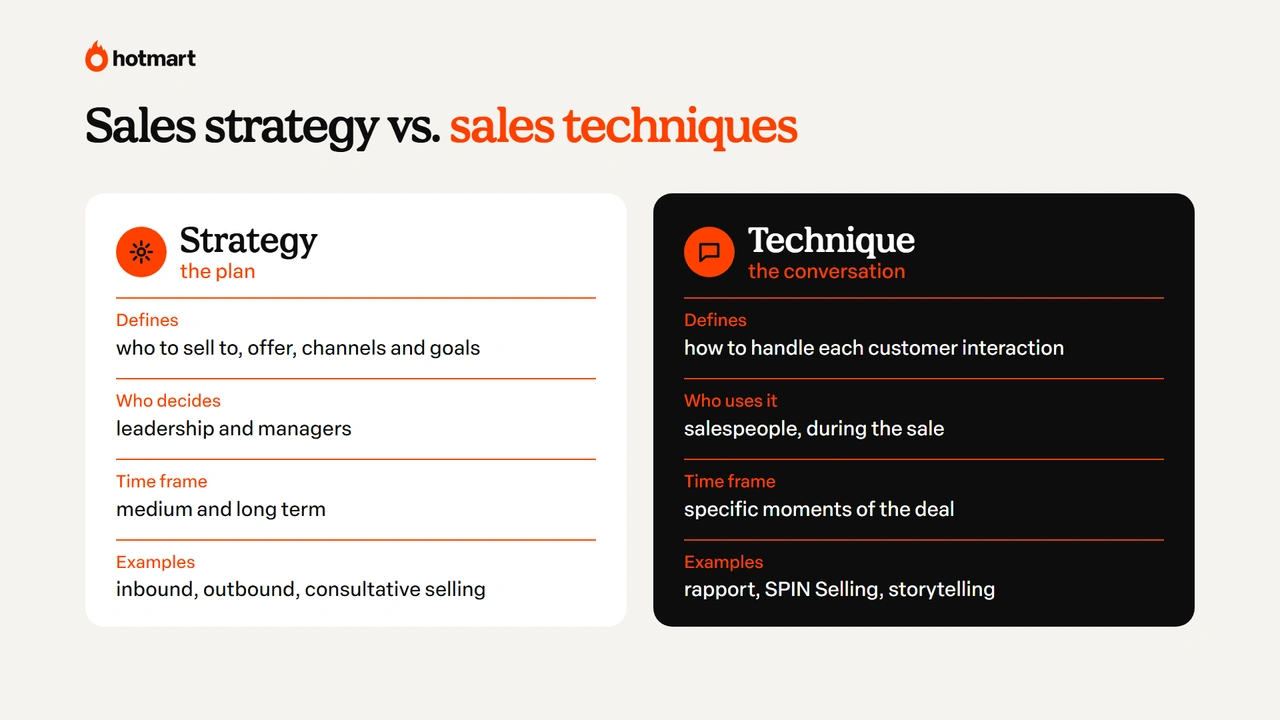
The difference between a sales strategy and a sales technique is that the strategy defines the sales plan, while the technique determines how to handle each interaction with the customer. In other words, the strategy guides what to do and why, and the technique helps you carry out that plan.
Think of a soccer team. The strategy is the game plan the coach sets, with player positions and match goals. The technique is in the execution of every pass, dribble and shot.
Sales works the same way. A company can adopt consultative selling as its strategy and use questioning, active listening and negotiation techniques during each conversation.
Here are the main differences:
| Criteria | Sales strategy | Sales technique |
|---|---|---|
| What it defines | The plan to win customers and hit targets | How to handle a sales interaction |
| Who decides | Leadership, managers and business owners | Salespeople, following the defined process |
| Time frame | Usually guides medium and long-term actions | Applied at specific moments of the deal |
| Examples | Inbound, consultative selling, prospecting, outbound and referral programs | Rapport, SPIN Selling, storytelling and psychological triggers |
Want to go deeper? Check out our article on sales techniques for beginners.
Why do you need a sales strategy?
A sales strategy gives direction to your sales efforts, makes revenue more predictable and shows you what’s working. With clear goals, a company can allocate resources better and make decisions based on results.
Imagine a store that spends on ads to attract customers but doesn’t track how many people buy after clicking. Even if sales go up, the business might be spending more than it should to win each customer.
With a defined strategy, you can track your investments, compare channels and see which actions generate the best opportunities.
The main benefits include focusing on the right customers, making better use of your budget, aligning marketing and sales and fixing problems before they hurt results. With an integrated marketing and sales strategy, marketing attracts the right people and the sales team knows how to handle each conversation.
Types of sales strategies
The main types of sales strategies are inbound, outbound, consultative selling, direct and partner channel sales, account-based marketing (ABM), upsell and recurring revenue for existing customers, and omnichannel. Each one meets different needs, and a single business can combine two or more.
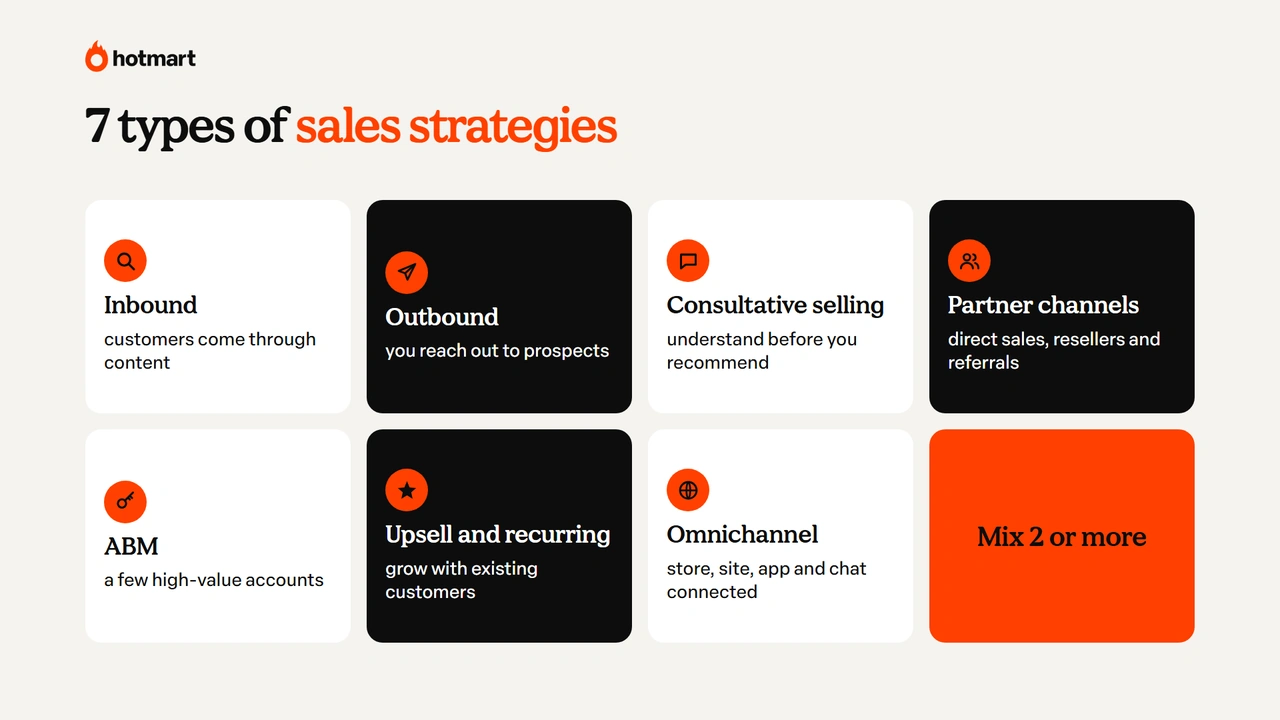
Here are the seven types we’ll cover:
- Inbound sales;
- Outbound sales;
- Consultative selling;
- Direct and partner channel sales;
- Account-based marketing (ABM);
- Upsell, cross-sell and recurring revenue;
- Omnichannel sales.
Inbound sales
Inbound sales is a strategy where customers come to the company, drawn in by content, online searches or social media. Instead of reaching out directly, the business creates information that sparks interest and helps people decide.
This strategy works for companies that can educate their audience before the sale, such as schools, service providers and online businesses. It’s the foundation of most sales strategies in digital marketing.
HubSpot, for example, uses educational content about marketing and sales to reach professionals interested in those topics. When they look for a solution, visitors can discover the company’s tools.
Outbound sales
Outbound sales happens when a company actively reaches out to potential customers by phone, email or LinkedIn. Outbound marketing turns this into a structured prospecting routine.
It’s common in B2B businesses, specialized services and higher-value products, where the buying decision usually involves several people.
Picture an HR consultancy that identifies growing companies and contacts their managers to offer recruiting services. Here, the sales opportunity starts with the consultancy’s own initiative.
Consultative selling
Consultative selling is a strategy where the salesperson works to understand the customer’s needs before recommending a solution. The goal isn’t just to pitch a product, but to find the offer that truly solves the buyer’s problem.
This approach works well for custom services, business software and products that require a more careful decision.
Imagine a company looking to buy management software. Before presenting plans, the salesperson tries to understand the size of the operation, the current challenges and the features needed. With that information, they can recommend a better-fitting solution and answer questions more precisely.
Direct and partner channel sales
In direct sales, the company sells its own products. In partner channel sales, third parties help promote, refer or distribute the offers.
A well-known example is Avon, which combines its network of independent sales representatives with online sales.
For a smaller business, this strategy can involve sales reps, resellers or referral programs. The right choice depends on the product, the structure available and how your audience prefers to buy.
Account-based marketing (ABM)
Account-based marketing (ABM) focuses sales efforts on a select group of companies with high business potential.
Instead of trying to reach as many customers as possible, the company creates personalized approaches for specific organizations.
Imagine a tech company that wants to sell a system to large hospital networks. It can study each institution’s needs, identify the decision-makers and prepare presentations tailored to each organization’s challenges. This strategy usually makes the most sense in B2B operations with higher-value contracts and complex buying processes.
Upsell, cross-sell and recurring revenue
Upsell, cross-sell and recurring revenue are strategies that expand the relationship with existing customers. They create new revenue opportunities without relying only on winning new buyers.
Each one works differently:
- Upsell: offering an upgraded version of the product or service.
- Cross-sell: recommending a product that complements the main purchase.
- Recurring revenue: offering a subscription or service with periodic payments.
A simple cross-sell example is the fast-food combo, when customers are offered fries and a drink with their order. A streaming platform uses recurring revenue by charging a subscription to keep access to the service. For people who sell digital products, Hotmart’s Order Bump is a cross-sell example: the complementary offer appears right at checkout.
Omnichannel sales
Omnichannel sales connects different channels to create a seamless customer experience, no matter where the journey starts or ends.
That means connecting physical stores, website, app, chat and social media, so customers don’t have to start over at every touchpoint.
One example is buy online, pick up in store, offered by retailers like Target. Customers browse in the app, pay online and pick up their order at a nearby store.
Here’s a summary of when to use each type:
| Type | When it makes sense | Example |
|---|---|---|
| Inbound | When you can educate your audience before they buy | HubSpot and its marketing and sales content |
| Outbound | B2B sales and higher-value products | An HR consultancy reaching out to growing companies |
| Consultative selling | Custom solutions and complex decisions | Selling management software |
| Direct and partner channels | When third parties extend your reach | Avon, with sales reps and online sales |
| ABM | A few high-value accounts | Software for large hospital networks |
| Upsell, cross-sell and recurring | Growing with existing customers | Fast-food combos and streaming subscriptions |
| Omnichannel | Customers who move between channels | Target’s buy online, pick up in store |
How to build a sales strategy in 7 steps
To build a sales strategy, start by assessing where your business stands, set goals and identify the customer you want to reach. Then choose your offer, channels and sales process, and track results so you can adjust.
Here’s the step by step:
- Assess your business and market.
- Set objectives and goals.
- Identify your ideal customer.
- Define your value proposition and offer.
- Choose your channels and strategy type.
- Map out your sales process and funnel.
- Track results and adjust.
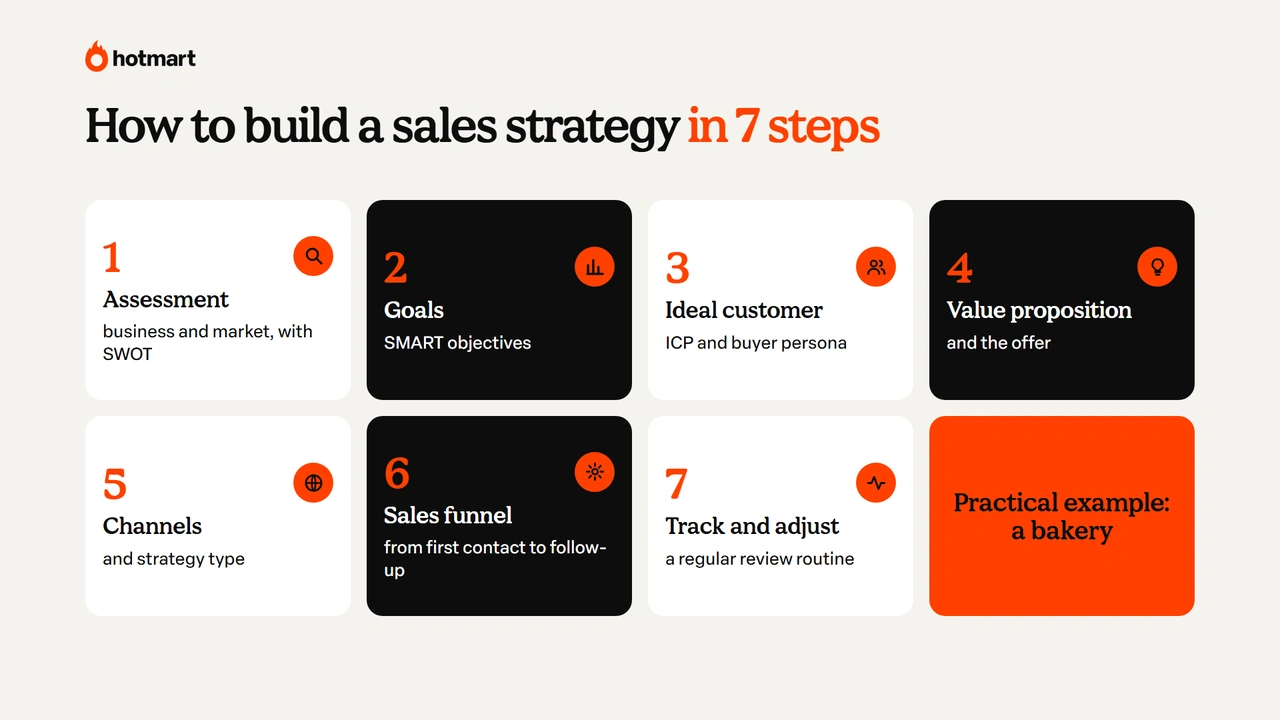
If you’re just getting started, this roadmap works as a sales strategy for beginners. To make it concrete, let’s follow a hypothetical example: a bakery that wants to increase orders for custom cakes.
1. Assess your business and market
Before planning new actions, look at your current results. Check how many sales you make, which products sell best, how customers find you and what problems come up during service.
A useful tool is the SWOT analysis, which organizes strengths, weaknesses, opportunities and threats. For the bakery, the assessment might show:
- Strength: custom cakes with great customer reviews.
- Weakness: slow replies to quote requests.
- Opportunity: growing demand for parties and celebrations in the area.
- Threat: competitors with faster delivery and a stronger online presence.
With this information, it’s easier to set priorities. Before investing in new ads, for example, the bakery may need to improve how it handles inquiries.
2. Set objectives and goals
After the assessment, define the result you want to achieve and the deadline.
One way to structure this is the SMART framework, which helps you set goals that are specific, measurable, achievable, relevant and time-bound.
Instead of just “selling more cakes”, the bakery could set this goal: increase revenue from custom orders by 20% over the next three months while keeping the planned profit margin. With a clear goal, you can calculate how many extra orders you need and which actions will help you get there.
3. Identify your ideal customer
Knowing your audience is essential to choose the right products, channels and messaging. You can work with two concepts:
- Ideal customer profile (ICP): the characteristics of the customers most likely to buy.
- Buyer persona: a more detailed customer profile with needs, behaviors and motivations.
In the bakery example, the audience might include people planning kids’ parties, family celebrations and corporate events. A hypothetical persona could be a working mom planning her son’s birthday who looks for a reliable bakery on Instagram.
She values quality, but she also needs quick replies, clear pricing and confidence that the order will arrive on time. Understanding these needs helps you build a more relevant sales approach.
4. Define your value proposition and offer
Your value proposition explains why a customer should choose your business over the alternatives.
It should show what problem you solve and what makes your solution different. For the bakery, the proposition could be custom cakes for celebrations, with flavor options, fast service and scheduled delivery.
Then organize the offer around price, payment terms, lead times, cancellation policies and any guarantees. A clear presentation prevents confusion and makes comparisons easier. It’s also important to make sure the price covers your costs and hits your target margin.
5. Choose your channels and strategy type
With your audience and offer defined, choose where your business will find potential customers. The bakery could combine an inbound strategy, with content on Instagram, and direct sales through a messaging app.
In videos, it can show behind-the-scenes production, showcase different cake designs and answer common questions.
In messages, it can handle quotes, confirm order details and close sales. Ideally, start with the channels where your audience already spends time and that your business can manage well.
6. Map out your sales process and funnel
The next step is to organize the stages a customer goes through before buying. A simple sales funnel might look like this:
- Attraction: the customer finds a bakery video on Instagram.
- Interest: they visit the profile and browse the designs.
- Contact: they send a message asking for a quote.
- Proposal: they get details on flavors, sizes, prices and timing.
- Conversion: they confirm the order and pay.
- Follow-up: they receive the order and can leave a review.
Also decide who owns each stage and what the next step should be.
This is where sales techniques come into play. During the conversation, for example, the bakery can ask questions, like those in SPIN Selling, to understand the type of event and recommend the right cake size. What matters is that every interaction contributes to a clear, organized experience.
7. Track results and adjust
Once your strategy is running, set up a routine to review results. The bakery could check every week how many quote requests came in, how many turned into orders and the average order value.
Imagine Instagram is bringing in lots of inquiries but few sales. That could point to problems with service, how prices are presented or how well the offer fits the audience.
In that case, it’s worth reviewing the process before spending more on promotion. Tracking helps you see what needs adjusting and avoid decisions based on gut feeling alone.
A good sales strategy also respects customer trust. Using fake scarcity, inventing testimonials or promising results you can’t guarantee can lead to complaints, refund requests and damage to your reputation. The goal isn’t to pressure anyone into buying, but to present a solution that truly fits the customer’s needs.
Which metrics should you track in your sales strategy?
The main sales strategy metrics are conversion rate, average order value, customer acquisition cost (CAC), customer lifetime value (LTV), sales cycle length and churn rate. These indicators help you see whether your sales efforts are delivering the expected results.
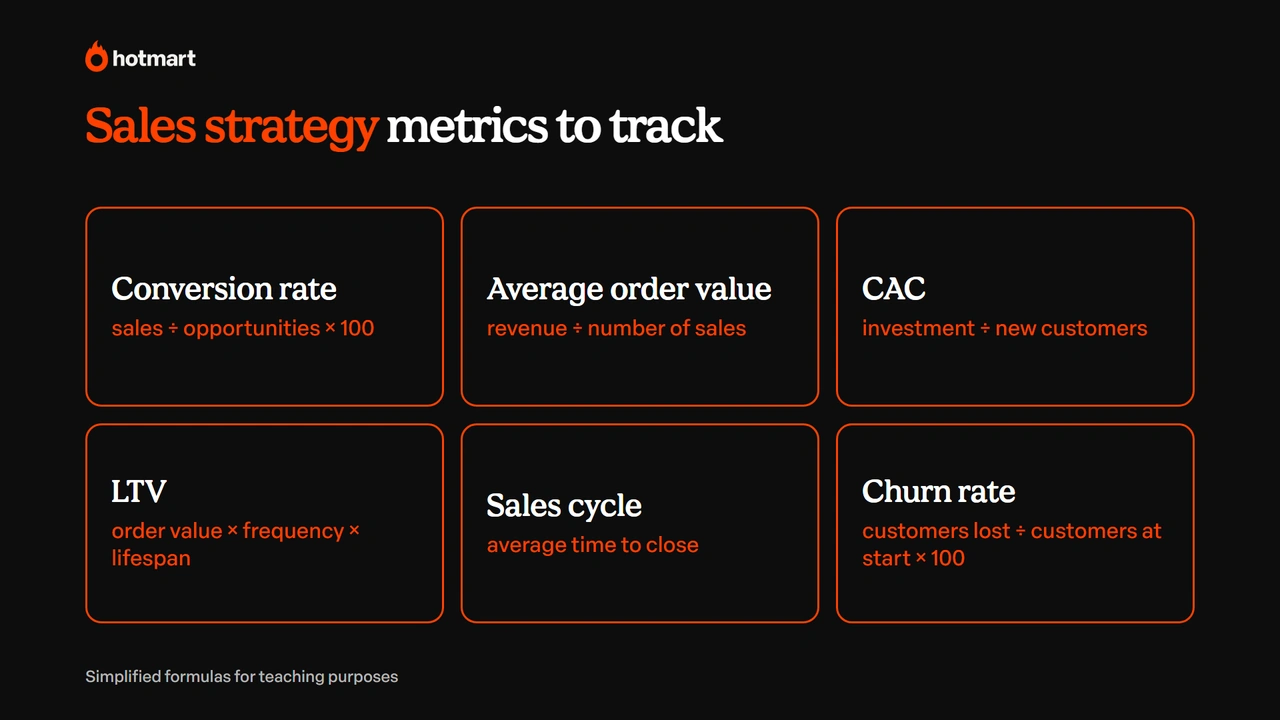
You don’t need to track dozens of numbers from day one. Choosing a few relevant indicators and reviewing them regularly is usually more useful than a dashboard full of data that doesn’t guide decisions. Here are the main metrics and how to calculate them:
| Metric | What it shows | How to calculate it |
|---|---|---|
| Conversion rate | Percentage of opportunities that turn into sales | (Sales ÷ opportunities) x 100 |
| Average order value | Average value of each purchase | Revenue ÷ number of sales |
| CAC | Cost to win a new customer | Marketing and sales spend ÷ new customers |
| LTV | Estimated revenue a customer generates over the relationship | Average order value x purchase frequency x average customer lifespan |
| Sales cycle | Average time to close a sale | Total time of closed deals ÷ number of closed deals |
| Churn rate | Percentage of customers lost in a period | (Customers lost ÷ customers at the start of the period) x 100 |
These formulas are simplified for teaching purposes. LTV, for example, can also factor in contribution margin, retention and your business model.
Sales strategies for digital products
If you sell digital products, like online courses, ebooks and mentoring programs, you apply the same sales strategy logic, with tools specific to the digital market to attract students, increase the value of each purchase and build long-term relationships.
In practice, that means understanding your audience, creating a relevant offer, choosing your channels and tracking results.
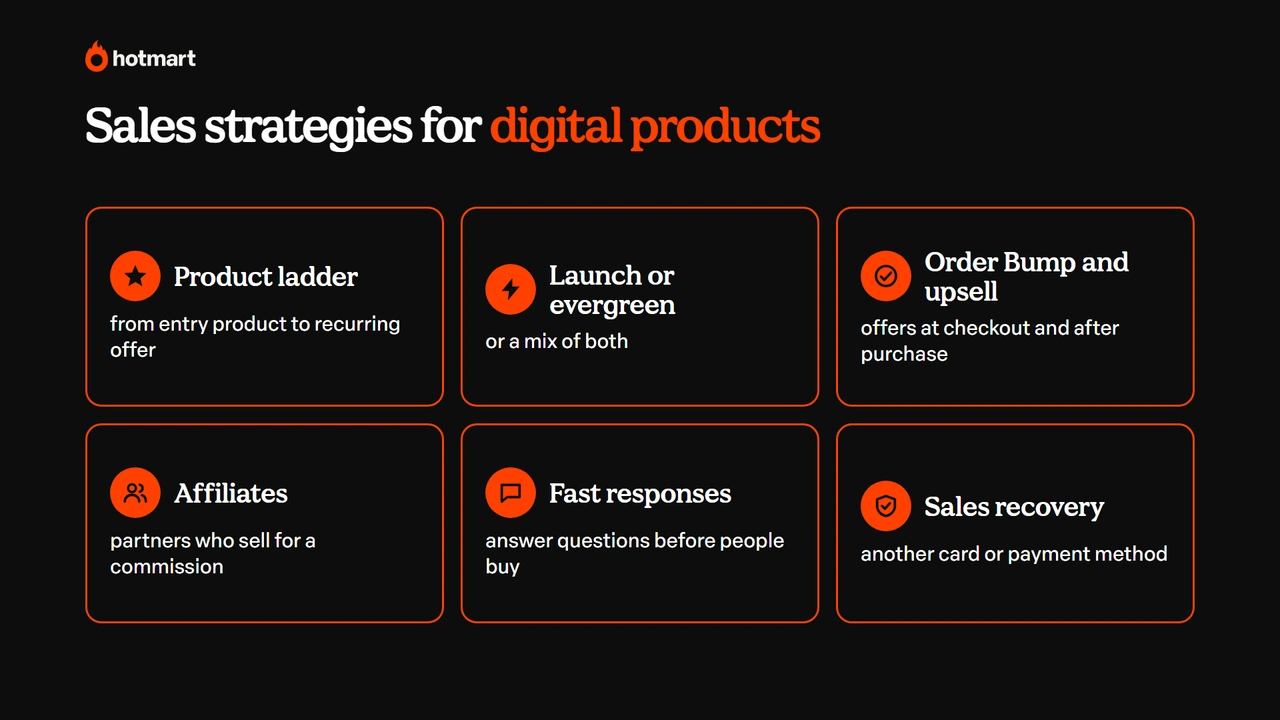
Here are six sales strategies you can apply to the digital market (and, to go further, our guide on how to sell digital products online):
- Product ladder;
- Launch or evergreen sales;
- Order Bump, upsell and post-purchase offers;
- Affiliate program;
- Fast responses so you don’t lose leads;
- Sales recovery.
Product ladder
A product ladder organizes different offers so customers can move up based on their needs and knowledge level. It can start with an entry-level product, move to a more complete program and include a premium or recurring offer.
For a recurring offer on your ladder, Hotmart lets you create subscription communities with posts, videos and live sessions for members. That way, creators can keep the relationship going and deliver new content over time.
Launch or evergreen sales
A product launch concentrates sales in a specific window, while evergreen sales keep the product available year-round. Both strategies can work for digital products, depending on your audience and business model.
A launch can be a great way to open a new mentoring cohort, for example. The creator publishes warm-up content, hosts a special class and opens enrollment for a set period.
With evergreen sales, a recorded course can stay available all year, with content and campaigns driving visitors to the sales page. You can also combine both: sell an introductory course continuously and run periodic launches for an advanced program.
Order Bump, upsell and post-purchase offers
Complementary offers help increase average order value by presenting products related to the main purchase. The difference lies in when and how each offer appears.
Order Bump, for example, lets you offer an add-on product right in the Hotmart checkout. Imagine a student buying a personal finance course. During payment, they could get the option to add a monthly budget spreadsheet.
An upsell can present a more complete version of the program, while a post-purchase offer can recommend related content. What matters is that the extra offer is genuinely useful to the buyer and doesn’t get in the way of the main purchase.
Affiliate program
An affiliate program lets other people promote your digital products and earn a commission on the sales they make. It’s how the partner channel strategy works in the digital market, and it’s the core of affiliate marketing.
On Hotmart, the creator makes the product available for affiliates and sets the commission, and affiliates find the offer in the Hotmart Marketplace.
Imagine an English teacher who created a course for professionals who want to work abroad. She could partner with creators who talk about international careers and language learning.
To set up this strategy, define a commission that fits your margin, choose partners aligned with your audience and provide materials that make promotion easier.
Fast responses so you don’t lose leads
Answering potential customers’ questions quickly can keep a sales opportunity from slipping away before they decide to buy. This matters even more when people land on your sales page outside business hours.
Automated replies, a strong FAQ section on the sales page and a support channel with clear response times help you follow up on opportunities that come in at any hour.
Sales recovery
Sales recovery aims to complete purchases that didn’t go through because of payment issues or other checkout problems.
Imagine someone decides to buy a course, but their card is declined for insufficient funds. Even if they’re interested, they may give up if they can’t find another way to pay.
On Hotmart, the Automatic Sales Recovery tool steps in: when a transaction is declined, it can retry the charge and, if needed, offer another card or payment method. It happens in less than a second and at no extra cost.
Ready to build your sales strategy?
Now that you know what a sales strategy is, it’s easier to see why selling more takes planning, not just more promotion.
As we’ve seen, the strategy defines your goals, audience, channels and sales process, while sales techniques help you put that plan into action in every customer conversation.
You don’t have to pick just one approach either. A business can combine inbound, consultative selling, partner channels and complementary offers, as long as each one has a clear purpose.
What matters most is to start with an assessment, set realistic goals and track your metrics to see what needs improving.
And if you sell digital products, Hotmart’s tools help you structure every stage of the journey, from creating offers and promoting through affiliates to recovering sales. You bring the talent, we bring the tools.
Sales strategy FAQ
Still have questions? Here are answers to the most common questions about sales strategy.
What's the difference between a sales strategy and a sales plan?
A sales strategy defines the choices that drive growth, such as audience, positioning, channels and sales model. A sales plan organizes how those decisions get executed, with actions, owners, deadlines and resources.
What is the best sales strategy?
There's no single best sales strategy for every business. The right choice depends on your customer profile, product, budget and goals. A B2B company might prioritize consultative selling, while an online store might combine inbound, ads and complementary offers.
How do you create an online sales strategy?
To create an online sales strategy, define your audience, set goals, choose the most relevant digital channels and map out the buying journey. Then track metrics like traffic, conversion rate, average order value and acquisition cost to find opportunities to improve.
How long does it take for a sales strategy to work?
It depends on the type of strategy, the market and the buying cycle. Campaigns aimed at people who already know your brand can produce results faster, while content, B2B prospecting and relationship building usually take longer. Set goals and review periods that match your business reality.