
Workshop: What It Is, How It Works and How to Run Your Own (In Person or Online)
Learn what a workshop is, how it differs from a course and a webinar, how to run your own in 8 steps (in person or online) and how to turn it into a digital product.

What will we see in this post

Have you ever left a talk full of ideas and, a week later, put none of them into practice? A workshop exists to solve exactly that: instead of just listening, participants roll up their sleeves and walk away with something finished.
In this guide, you’ll learn what a workshop is, how it works, how it differs from a course, a talk and a webinar, and how to run your own in 8 steps, in person or online. At the end, we show you how to turn a workshop into a digital product. Let’s get started! 🛠️
| Question | Quick answer |
|---|---|
| What is a workshop? | A short, hands-on session where participants learn by doing, guided by the person leading it |
| How long does it last? | From a few hours to two or three days |
| How is it different from a course? | A course is longer and more complete; a workshop is short and focused on a practical result |
| Can it be online? | Yes, live over video call, with exercises and real-time interaction |
| Can you make money with it? | Yes, by selling tickets and turning the recording into a digital product |
What is a workshop?
A workshop is a short, hands-on session in which a group learns a topic through exercises and activities, guided by an expert. The word originally means a room where things are made or repaired, and that idea still applies: in a workshop, you work with your hands and your head, not just your ears.
What defines a workshop is practice. There is some theory, but it’s brief and serves as the foundation for what comes next: exercises, group activities, case studies and peer exchange. By the end, each person leaves with something concrete, like a plan, a draft, a finished piece or a skill they’ve actually tested.
Workshops show up in almost every field: marketing, photography, cooking, writing, personal finance, technology, crafts and personal growth. They can take place in a meeting room, a studio or on a video call, and bring together anywhere from a handful of people to a few dozen.
How a workshop works
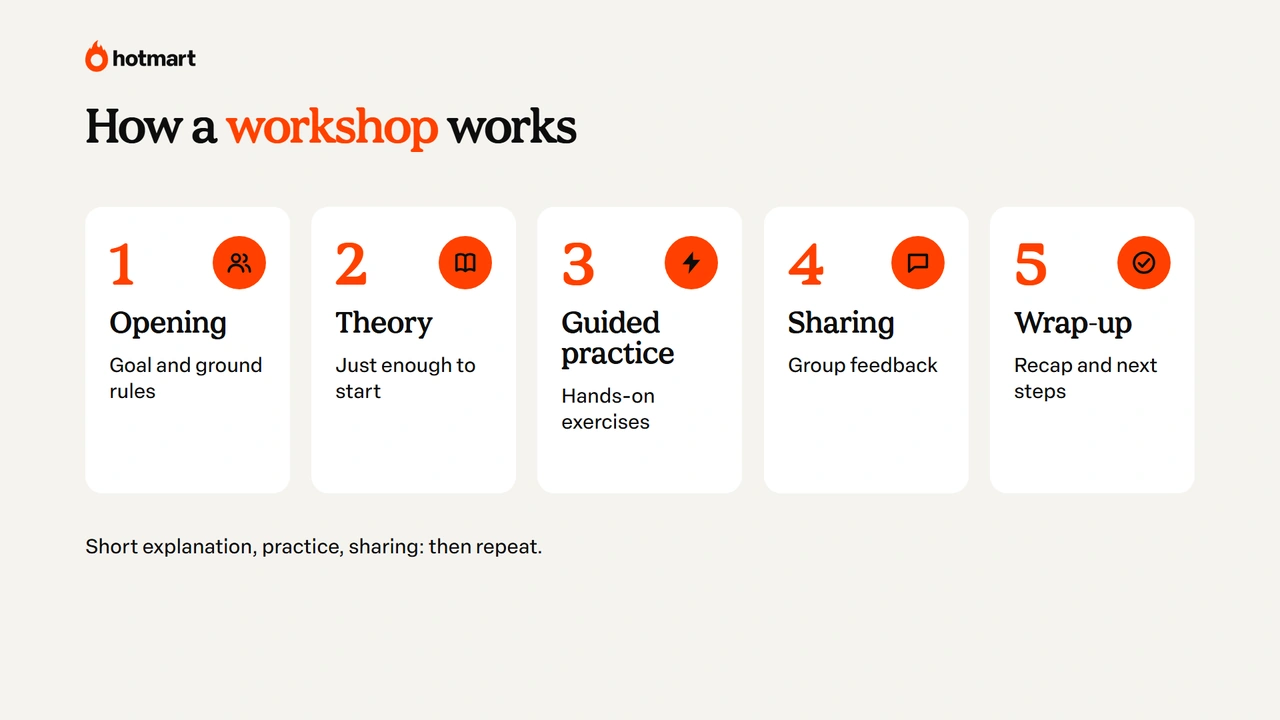
A workshop works as a cycle of learning and applying: a short block of explanation, followed by an exercise, a round of sharing and then the next block. The most common structure has five stages:
- opening: introductions, the goal of the session and ground rules;
- theory basics: just enough concept to tackle the first activity;
- guided practice: individual or group exercises, with the facilitator walking around and answering questions;
- sharing: each person or group shows what they made and gets feedback;
- wrap-up: summary, next steps and take-home materials.
A workshop can last anywhere from two or three hours to two or three days, and groups tend to be small, so everyone can take part and get attention. The more hands-on the topic, the smaller the group usually is.
What a workshop is for
A workshop is a way to turn knowledge into practice in a short amount of time. For participants, it helps them:
- learn by doing, which makes it easier to remember and apply;
- get questions answered on the spot by the person leading the session;
- share experiences with people who have the same interests;
- leave with a concrete result, not just a page of notes.
For the organizer, a workshop is also good business. It builds authority on the topic, strengthens your relationship with your audience and can be a source of income, sold as a standalone ticket or as a gateway to a course or a mentoring program. It’s also a quick way to test a product idea before investing in a full course.
Workshop vs course vs talk vs webinar: what’s the difference?
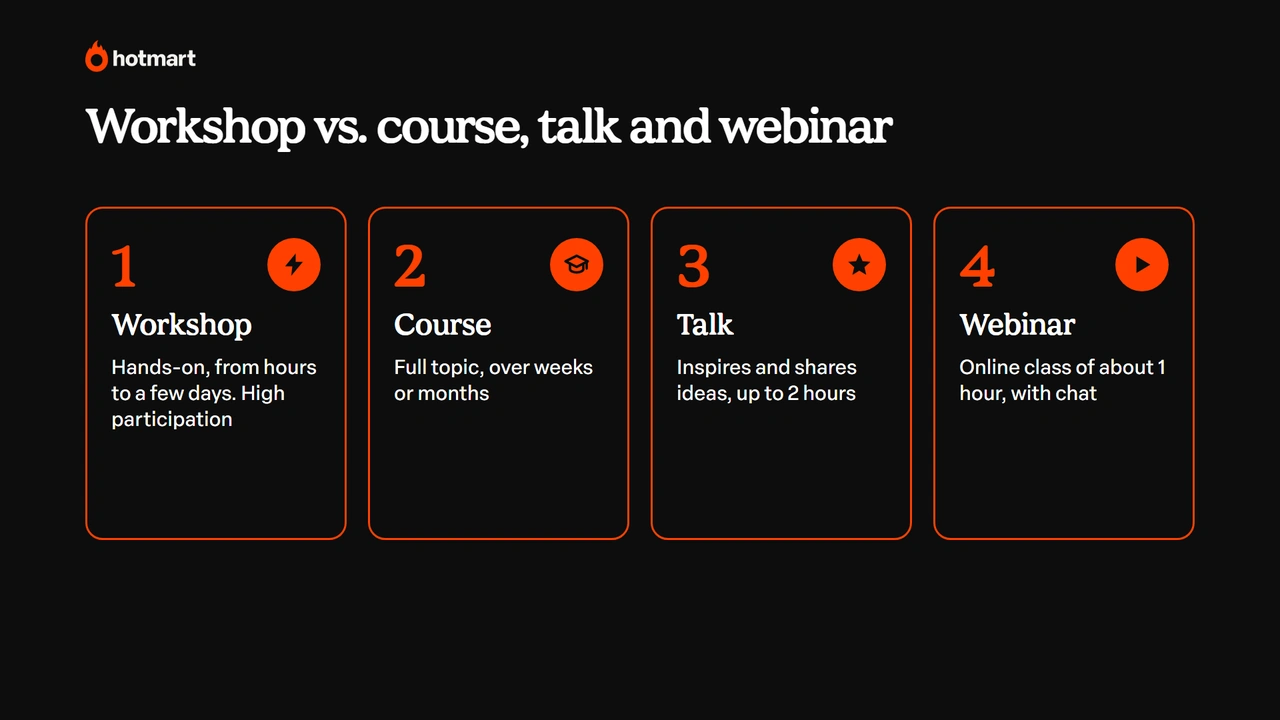
The difference between a workshop, a course, a talk and a webinar comes down to purpose, length and how much the audience participates. The workshop is the most hands-on of them all: participants learn by doing.
| Format | Purpose | Length | Audience participation |
|---|---|---|---|
| Workshop | Apply knowledge in practice | A few hours to a few days | High: exercises and peer exchange |
| Course | Teach a topic in depth | Weeks or months | Medium: lessons, activities and assessments |
| Talk | Inspire or present an idea | Up to 1 or 2 hours | Low: the audience watches |
| Webinar | Teach or present a topic online | About 1 hour | Low to medium: chat and Q&A |
In practice, these formats work well together: a free webinar can lead to a paid workshop, and a workshop can become the first module of a course. If you’re trying to decide between the two main formats, take a look at this full comparison of a course or workshop for your classes.
Types of workshops
The types of workshops vary depending on format and audience. The most common ones are:
- in-person workshop: takes place in a physical space, with materials on hand and face-to-face interaction;
- live online workshop: happens over video call, with exercises and real-time exchange;
- hybrid workshop: part of the group is in the room and part joins online;
- corporate (in-house) workshop: designed for a company’s team, on a work-related topic;
- open workshop: anyone can buy a ticket and join.
Choose your workshop format based on topic and audience: hands-on crafts (baking, pottery, product photography) call for being in the same room, while digital topics (marketing, AI, spreadsheets, writing) work really well online and reach people anywhere.
How to run a workshop in 8 steps
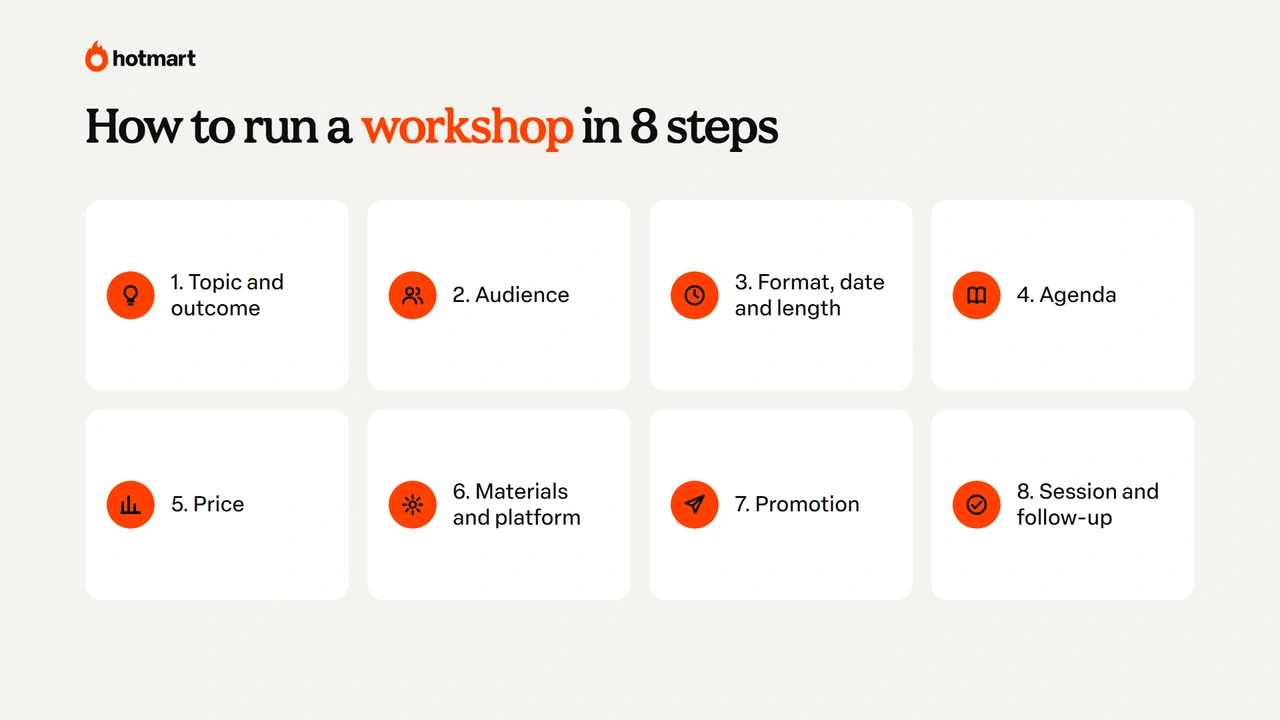
Running a workshop is simpler than it seems, as long as you plan the participant’s experience from start to finish. Here’s the step-by-step:
- define the topic and the outcome;
- get to know your audience;
- choose the format, date and length;
- build the session agenda;
- set the price;
- prepare materials, venue or platform;
- promote the workshop;
- run the workshop and follow up afterward.
Below, we break down each step.
1. Define your workshop topic and outcome
Pick a topic you know well and that solves a specific problem. Then write down, in one sentence, what people will be able to do when they leave: “walk out with next month’s content calendar ready” sells better and guides your agenda better than “learn about social media”.
2. Get to know your workshop audience
Understand who will attend: their level of knowledge, their most common questions and what they expect from the session. If you’re not sure yet, define your target audience and talk to a few people before finalizing the content.
3. Choose the workshop format, date and length
Decide between in person, online or hybrid, and pick a date far enough out to give you time to promote it. For a first workshop, two to four hours is usually a good length: enough to go deep without wearing the group out. If the session is larger and open to the public, the same planning that goes into an online event applies here too.
4. Build your workshop agenda
Split your time into blocks of explanation and practice, alternating between the two. A useful rule of thumb is to never talk for more than 15 or 20 minutes without giving people something to do, and your supporting slides should follow the same principles as a professional slide presentation: little text and one idea per slide. Build in breaks and save time at the end for questions and next steps.
5. Set your workshop price
Your workshop price depends on the topic, the length, the group size and your authority in the field. Compare it with similar events and with the value of the result participants take home. If you want to dig deeper, the principles for pricing your digital product also work for workshops.
6. Prepare materials, venue or platform
Put together your support materials (workbooks, templates, spreadsheets, checklists) and test everything ahead of time. For an in-person session, take care of the room, the sound and each participant’s materials; online, test the platform, your connection, your audio and screen sharing.
7. Promote your workshop
Create a workshop page with the promise, the agenda, the date, the price and who’s leading it. Share it on social media, with your email list and in groups related to the topic, and use psychological triggers like limited spots only when they’re real.
8. Run the workshop and follow up afterward
On the day, start on time, explain the goal and keep a steady rhythm between theory and practice. Afterward, send the materials, the recording (if there is one) and a short feedback survey. The follow-up is the best moment to offer the next step, like a course or a mentoring program.
How to run an online workshop
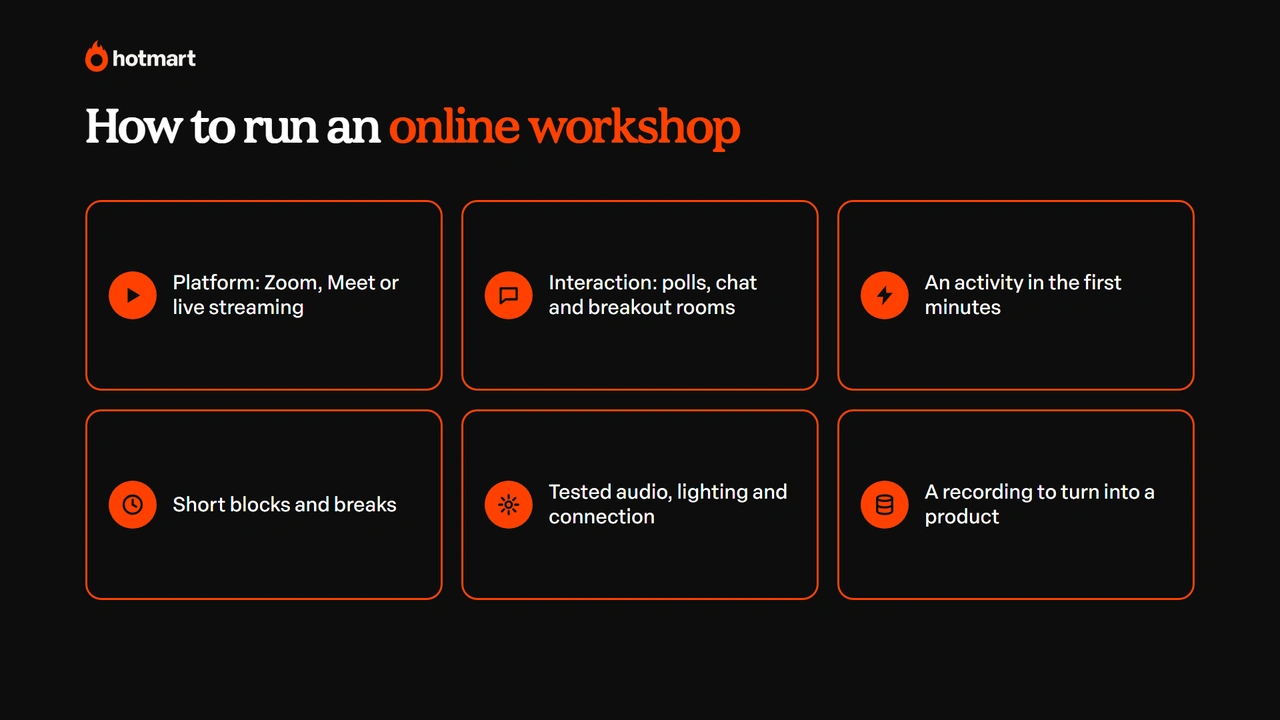
An online workshop works just like an in-person one, but interaction needs more careful planning, because it’s easy for people on the other side of the screen to get distracted. These are the things that make a difference:
- platform: Zoom and Google Meet work well for groups that need to turn on cameras and mics; tools built for live streaming, like StreamYard, are a better fit for large audiences;
- interaction: use polls, chat, breakout rooms for group exercises and collaborative whiteboards like Miro or Canva;
- pacing: short blocks, a break every hour and an activity within the first few minutes;
- tech setup: a lavalier or desk mic, good lighting and a stable connection matter more than an expensive camera;
- recording: let people know the session will be recorded and keep the file, because it can become a product later.
An online workshop also cuts venue and travel costs and lets you bring together people from different cities, or even different countries, in the same group. Before choosing a tool, test it with a small group and make sure it supports breakout rooms, screen sharing and recording.
Workshop ideas
The workshop ideas that work best solve a concrete problem in just a few hours. Here’s some inspiration by field:
| Field | Workshop ideas |
|---|---|
| Digital marketing | Monthly content calendar, your first ads, copywriting for a sales page |
| Social media | Short-form video from script to edit, a bio and profile that sell |
| Artificial intelligence | Prompts for everyday work, creating images with AI |
| Photo and video | Product photography with your phone, video editing for social media |
| Personal finance | Monthly budgeting, building an expense tracker spreadsheet |
| Creativity and arts | Hand lettering, watercolor, pottery, creative writing |
| Career and communication | Public speaking, presentation skills, résumé and LinkedIn profile |
| Cooking and baking | Sourdough bread, weekly meal prep, baked goods to sell (cookies, cupcakes, banana bread) |
Choose a topic where you have real experience and an audience that already asks you for help with it. That’s the best sign that the idea has demand.
How to turn a workshop into a digital product
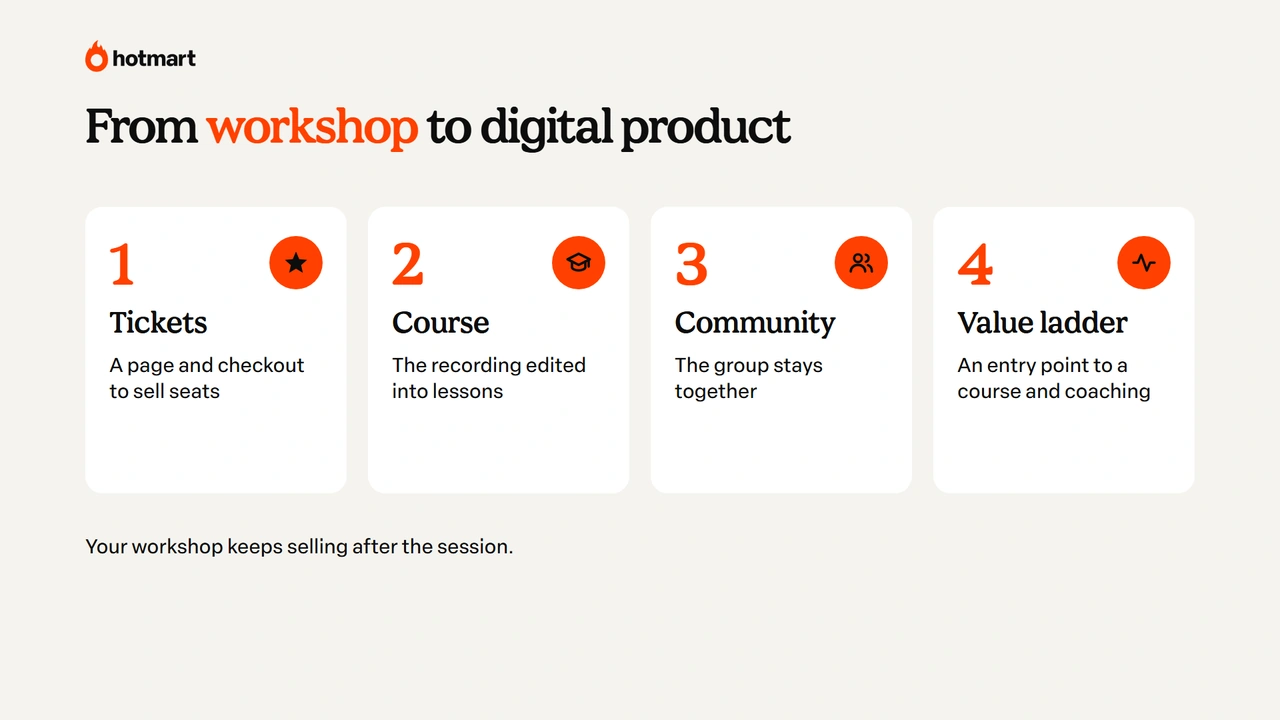
A workshop doesn’t have to end when the session does: it can become a digital product that keeps selling. Here are four ways to get more out of every edition:
- sell tickets with your own page and checkout;
- turn the recording into a course;
- keep the group active in a community;
- use the workshop as an entry point to other products.
Sell workshop tickets with your own page and checkout
To sell a workshop, you need a page that presents your offer and a secure way to get paid. If you don’t have a website yet, Hotmart Launchpad creates, from a description of your idea, a sales page or an event page with ticket sales, already published with a domain, hosting and Hotmart’s checkout.
Turn your workshop recording into a course
The recording of a good workshop, edited and split into lessons, can become a course for people who couldn’t attend live. On Hotmart, you can host that content in the members area, with modules, support materials and automatic certificates, and keep selling after the event.
Keep your workshop group engaged in a community
People who enjoyed the workshop usually want to keep learning and stay connected with the group. A subscription-based digital community keeps that group close, with meetups, challenges and fresh content.
Use your workshop as an entry point
An affordable workshop makes a great first purchase: participants get to know your method and feel more confident investing in the next step. That’s why it works well as the first stage of a sales funnel that can lead to a full course and a mentoring program.
Ready to get your workshop off the ground?
A workshop is the most hands-on way to teach: in just a few hours, participants learn by doing and leave with a concrete result. The secret lies in an agenda that alternates short explanations with practice, and in a clear promise of what people will be able to do by the end.
Start with a topic you know well, a small group and a two or three hour session, online or in person. Then use the recording and the group to create your next products, like a course, a community or a mentoring program. ✨
Frequently asked questions about workshops
Still have questions? Below, we answer some of the most common questions about workshops.
What does workshop mean?
A workshop originally meant a room or building where things are made or repaired. Today, the term is also used for short, hands-on sessions in which participants learn a topic through exercises and activities, guided by the person leading it.
What's the difference between a course and a workshop?
A course teaches a topic in depth, over weeks or months, with several lessons. A workshop is short, from a few hours to a few days, and focused on applying a specific skill in practice, with exercises and exchange between participants.
How long does a workshop last?
A workshop lasts anywhere from two or three hours to two or three days, depending on the topic and the promised result. If you're just starting out, a two to four hour session is usually enough.
Who can run a workshop?
Anyone with real experience in a topic and the ability to lead hands-on activities can run a workshop. You don't need a specific degree, but it's important to know your subject well and plan your agenda carefully.
Do online workshops work?
Yes, as long as the interaction is planned: activities right at the start, group exercises in breakout rooms, polls and breaks. The online format also lets you bring together people from different places and record the session to turn it into a product.