
Lead magnet: what it is, types, examples and how to create one that converts
Learn what a lead magnet is, explore 9 types with examples by niche and follow a step-by-step guide to create one that turns visitors into leads.


Someone finds your profile, enjoys your content and leaves without sharing any contact details. A lead magnet exists so that the conversation doesn’t end there.
In this article, you’ll learn what a lead magnet is, the formats that work best, examples by niche and a step-by-step guide to create your own. First, here’s a quick lead magnet summary:
| Question | Answer |
|---|---|
| What is a lead magnet? | A lead magnet is a free resource, such as an ebook, checklist or quiz, offered in exchange for a visitor’s contact details. |
| What is a lead magnet for? | A lead magnet helps you build your own contact list and prepare leads to buy. |
| What makes a lead magnet work? | A lead magnet works when it solves a specific problem, delivers a quick win and connects to your paid product. |
| How do you create a lead magnet? | To create a lead magnet, define the problem, pick a format, produce the material and publish a landing page with automatic delivery. |
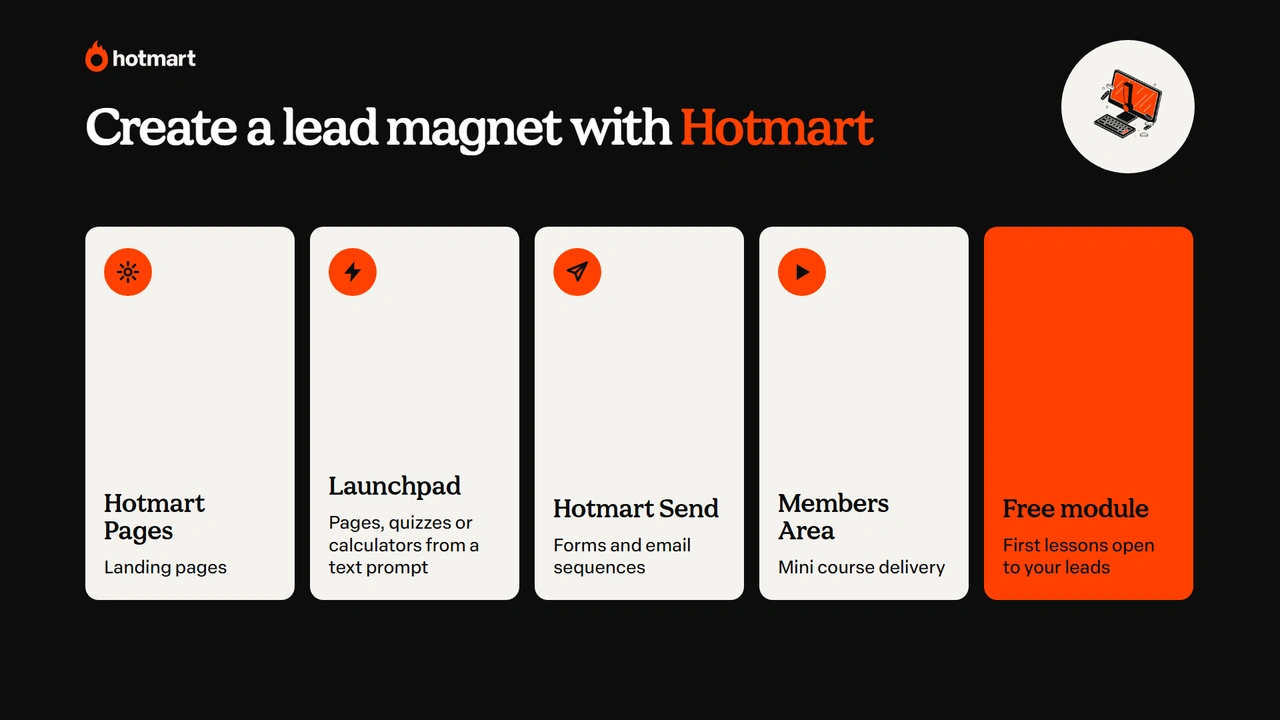
| How do you create a lead magnet with Hotmart? | With Hotmart, you build the page with Hotmart Pages or Launchpad, send emails with Hotmart Send and deliver the material in the Members Area. |
What is a lead magnet?
A lead magnet, also called an opt-in incentive or freebie, is a free resource or benefit offered in exchange for someone’s contact information, such as their name, email address or phone number. It’s a marketing strategy that turns interested visitors into leads, that is, potential customers your brand can keep building a relationship with.
Imagine you sell a photography course. Before pitching the full program, you can offer a free guide with five techniques to take better photos with your phone. To get it, people enter their email on a sign-up page.
The main difference between a lead magnet and free content posted on social media is that exchange. Anyone can watch a video or read a post without identifying themselves, but a lead magnet offers more focused content in exchange for contact details, so the relationship can continue afterward.
What is a lead magnet for?
A lead magnet helps you attract interested people, build a contact list and prepare potential customers for a future purchase. Instead of relying only on views and social media reach, you get a direct communication channel with people who have shown interest in your topic.
Another benefit is that you get to know your audience better. If you offer a personal finance checklist, for example, the people who download it probably want to learn how to manage their money.
From there, you can send related content, answer questions and present more complete solutions, such as a course or coaching program. This process is called lead nurturing, and it builds the relationship before the offer, which is how many creators sell digital products consistently.
What makes a lead magnet work
A high-converting lead magnet offers a clear benefit, solves a real need and is easy to consume. More than producing long material, what matters is delivering something your audience finds useful.
Here are six traits of a good lead magnet:
- It solves a specific problem: instead of a generic guide to healthy eating, offer a practical meal plan to organize the week.
- It delivers a quick win: a monthly budget spreadsheet lets people start organizing their finances as soon as they download it.
- It has high perceived value: a contract template reviewed by an expert, for example, can save freelancers a lot of time.
- It’s easy to consume: a one-page checklist can be more useful than a 50-page ebook nobody finishes.
- It’s tied to your paid product: if you sell a baking course, you can offer a list of the most common mistakes when making cake batter.
- It’s delivered instantly: after signing up, people should get access right away, without waiting for a manual send.
These criteria make the exchange more appealing to visitors and increase the chances that your material does its job in the strategy.
Types of lead magnets (with examples)
There are many types of lead magnets, and the right one depends on your topic, your audience and the product you plan to sell. Some formats are ideal for a quick fix, while others let you show your expertise in more depth.
Here are nine lead magnet ideas for your business:
- Ebook or guide;
- Checklist;
- Template or spreadsheet;
- Free lesson or mini course;
- Live class (webinar);
- Email or WhatsApp challenge;
- Quiz or assessment;
- Free tool;
- Coupon or free trial.
Below, you’ll see how each format works and who it suits best.
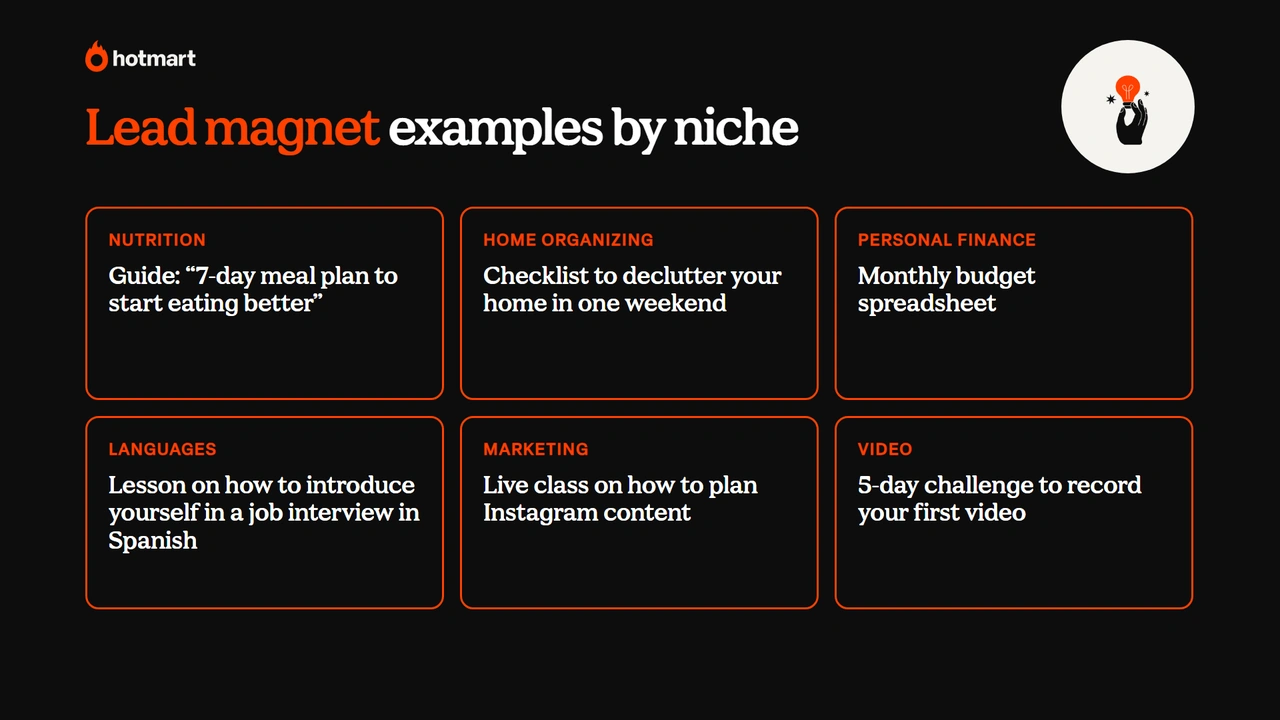
1. Ebook or guide
An ebook or guide is a written resource with practical advice on a topic. It’s one of the best-known lead magnet formats and works well to explain concepts, present methods or teach a skill.
A nutritionist who offers coaching, for example, can create the guide 7-day meal plan to start eating better. It helps people take their first steps and gives them a taste of your expertise, which they can go deeper into in a consultation or full program. If you want to start with this format, see how to create an ebook.

2. Checklist
A checklist is a lead magnet in the form of a to-do or verification list that helps people complete a task without missing important steps. Because it’s short and easy to use, it works well for anyone looking for an immediate solution.
Imagine a professional organizer who sells a home organization course. She can offer a Checklist to declutter your home in one weekend, with tasks split by room. That way, people put the advice into practice and get to know her teaching method.
3. Template or spreadsheet
Templates and spreadsheets are ready-made lead magnets that make tasks easier and save time. This format is especially useful for planning, organizing or tracking information.
A personal finance educator, for example, can offer a monthly budget spreadsheet to people who want to learn how to manage their money. Later, they can present a full course on financial planning.
4. Free lesson or mini course
As a lead magnet, a free lesson or mini course teaches a specific skill and shows the creator’s teaching method. It’s a great option for people who sell online courses, because it offers an experience close to the paid product.
Imagine a Spanish teacher who offers a lesson on how to introduce yourself in a job interview in Spanish. Besides learning useful phrases, students get to know the teacher’s style and may sign up for a full program.
On Hotmart, you can deliver this mini course in the members area, and you can also turn on a free module from your paid course so leads can watch the first lessons before buying.
5. Live class (webinar)
A webinar is a lead magnet in the form of an online class or presentation held on a set date and time, usually with room for interaction with attendees. It’s a popular format in product launch strategies.
A marketing specialist can host a free class on how to plan Instagram content. During the session, attendees see examples and ask questions in real time. At the end, she can present her coaching program to anyone who wants to go further.
6. Email or WhatsApp challenge
A challenge is a lead magnet made of a series of activities spread over a few days and sent by email or WhatsApp. The goal is to help participants build a skill or reach a result through small daily tasks.
A creator who teaches video production can offer a 5-day challenge to record your first video. Each day, participants get one practical task, from choosing a topic to hitting record.
This format encourages frequent contact with your brand and can prepare your audience for a more in-depth course on content creation.
7. Quiz or assessment
A quiz or assessment is a lead magnet built from a set of questions that delivers a personalized result at the end. Besides being fun, it gives you valuable data to understand who your audience is.
In personal finance, the Find out your investor profile quiz is a classic. Based on the answers, you can segment your leads into conservative and aggressive investors and send each group a different offer. It also feeds your lead scoring.
To build a quiz without coding, Hotmart’s Launchpad creates quizzes, simulators and calculators from a text description.
8. Free tool
Free tools are small apps, calculators or analyzers that solve a technical problem automatically. They deliver value instantly and can be used more than once, which keeps your brand part of people’s routine.
For example, someone who sells a personal finance course can offer a savings calculator, and a marketing educator can build a free analyzer that grades sales pages and suggests improvements. In exchange for the result, people share their email and become qualified leads.
9. Coupon or free trial
A coupon or free trial is a direct offer for people who are already deciding. It lowers the risk of buying by offering a first-purchase discount or a few days of free access to a subscription, much like a freemium model.
This type of lead magnet works best with people who already know your work and are close to deciding. A first-purchase discount or a few days of access help overcome doubts about content quality and speed up the decision.
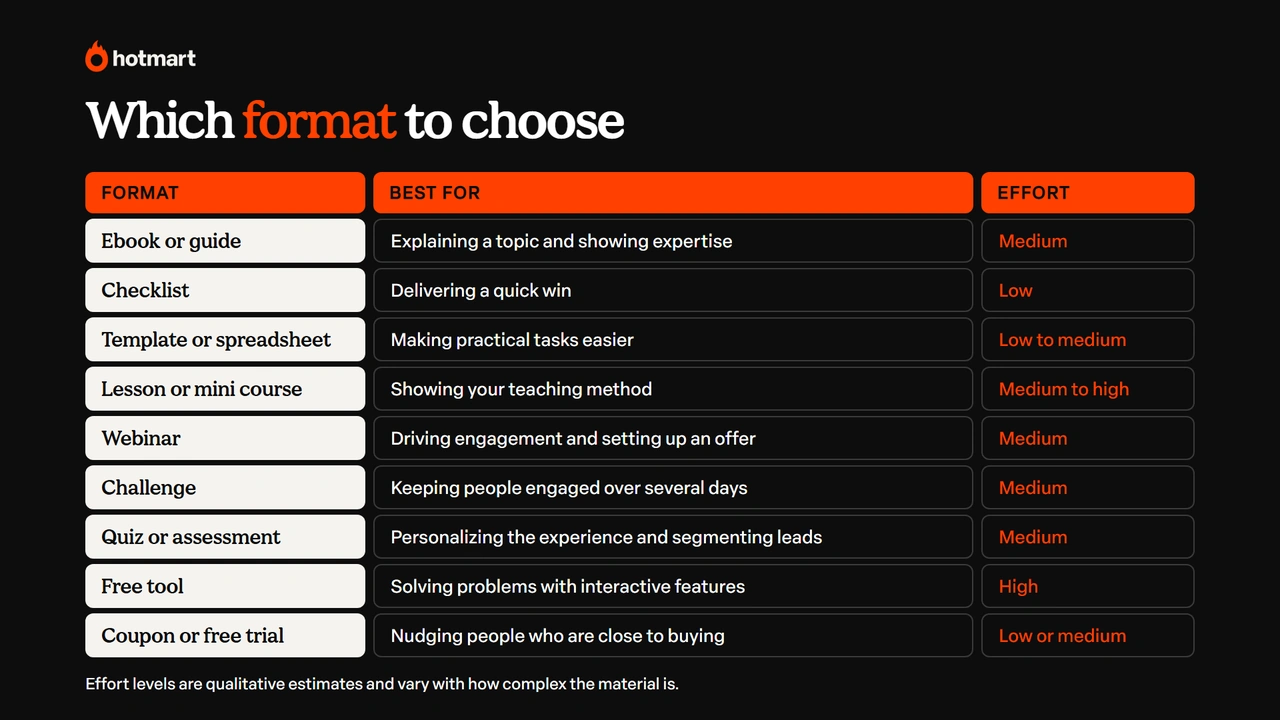
Here’s a summary of the nine lead magnet formats:
| Format | Best for | Estimated production effort |
|---|---|---|
| Ebook or guide | Explaining a topic and showing expertise | Medium |
| Checklist | Delivering a quick win | Low |
| Template or spreadsheet | Making practical tasks easier | Low to medium |
| Lesson or mini course | Showing your teaching method | Medium to high |
| Webinar | Driving engagement and setting up an offer | Medium |
| Challenge | Keeping people engaged over several days | Medium |
| Quiz or assessment | Personalizing the experience and segmenting leads | Medium |
| Free tool | Solving problems with interactive features | High |
| Coupon or free trial | Nudging people who are close to buying | Low or medium |
Effort levels are qualitative estimates. They vary with how complex the material is and the resources you have.
How to create a lead magnet step by step
To create a lead magnet, you need to identify an audience need, choose a useful format, produce the material and set up delivery. Then, promote it and track the results to find out what can be improved.
Here are the six steps to create a lead magnet:
- Define your audience and their problem.
- Choose a format tied to the product you sell.
- Produce the material.
- Build a landing page.
- Deliver instantly and keep the conversation going.
- Promote it and track the results.
Here’s how to put each step into practice.
1. Define your audience and their problem
Start by identifying who you want to attract and which problem you want to solve. The more specific the problem, the easier it is to create a relevant offer.
A good way to find ideas is to look at the questions you get in comments, direct messages and conversations with clients.
If you sell a baking course and notice that many people struggle to get their batter right, for example, that could be the topic of your first lead magnet.
2. Choose a format tied to the product you sell
Your lead magnet should solve a first need, while your paid product offers the complete learning path.
In the baking example, you could create the checklist 5 mistakes that ruin your cake batter. It helps people spot common problems and also sparks interest in learning more advanced techniques.
This connection makes your future offer feel natural, since the free content and the paid product meet related needs.
3. Produce the material
Once you have the topic and format, start producing your lead magnet. It doesn’t need to be long, but it does need to keep the promise you made.
You can use tools like Canva for design and artificial intelligence to structure a first draft. What matters most is reviewing the information and adding your experience, examples and guidance.
Before publishing, test the material and make sure it really solves the problem you promised to solve.
4. Build a landing page
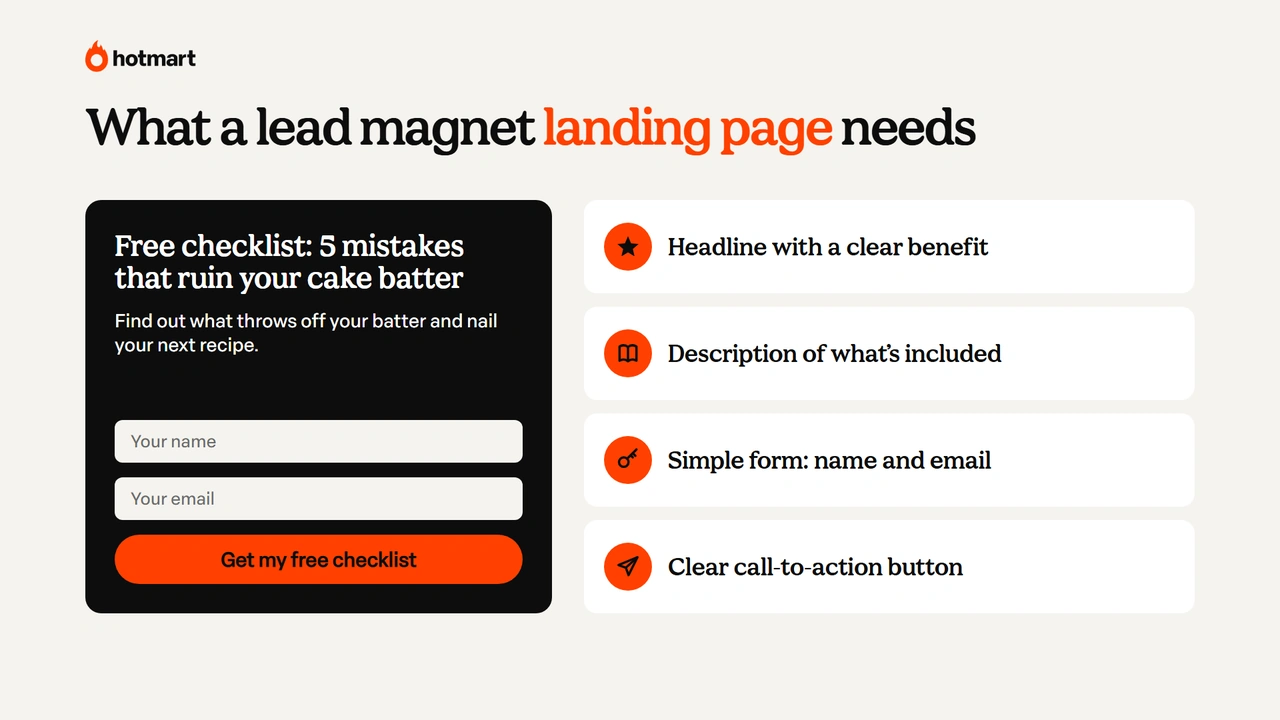
A lead magnet landing page is where visitors learn about your offer and share their details to get the material. If you’re new to the format, read what is a landing page.
To work well, it needs:
- A headline with a clear benefit: explain what people will achieve with the content.
- A clear description: show what’s included in the material.
- A simple form: ask only for the information you need, such as name and email.
- A call-to-action button: use direct copy, such as “Get my free checklist”.
On Hotmart, you can build the page with Hotmart Pages and set up the form with Hotmart Send, which stores and organizes the contacts you capture. If you’d rather create the page from a text description, without coding, Launchpad also builds pages and tools such as quizzes and calculators.
When you collect personal data, show a clear privacy policy and explain how the data will be used. Follow the rules where your audience lives, such as GDPR in the EU and UK and CAN-SPAM for marketing emails in the US.
5. Deliver instantly and keep the conversation going
After signing up, people should get the lead magnet right away, by email, by WhatsApp or on a confirmation page with access to the content.
But the strategy doesn’t end at delivery. You can create a follow-up sequence to share extra tips, answer questions and present your product when it makes sense. On Hotmart, you can build that email sequence in Hotmart Send. These tips on how to use email marketing can help.
Imagine someone downloaded your baking checklist. Over the next few days, you can send a tip about oven temperature, share a video with mixing techniques and then present your full course.
This relationship is part of lead nurturing, a strategy that helps prepare potential customers to buy.
6. Promote it and track the results
With your lead magnet ready, it’s time to put it in front of people. You can promote the landing page in your Instagram bio, in posts, in ads (see how to buy website traffic), in blog articles, in video descriptions and through partnerships with other creators.
Then, track three metrics:
- Landing page conversion rate: the percentage of visitors who filled out the form.
- Cost per lead (CPL): how much you spent to get each contact, especially in paid campaigns.
- Lead-to-customer conversion: how many sign-ups bought something later.
If many people visit the page but few sign up, try a more specific headline, fewer form fields or a more obvious benefit.
Common lead magnet mistakes
The most common lead magnet mistakes are picking a topic that’s too broad, producing long material, ignoring the link to your paid product, asking for too much data, delivering late and going silent after sign-up. Each one hurts your results, even when the material is useful.
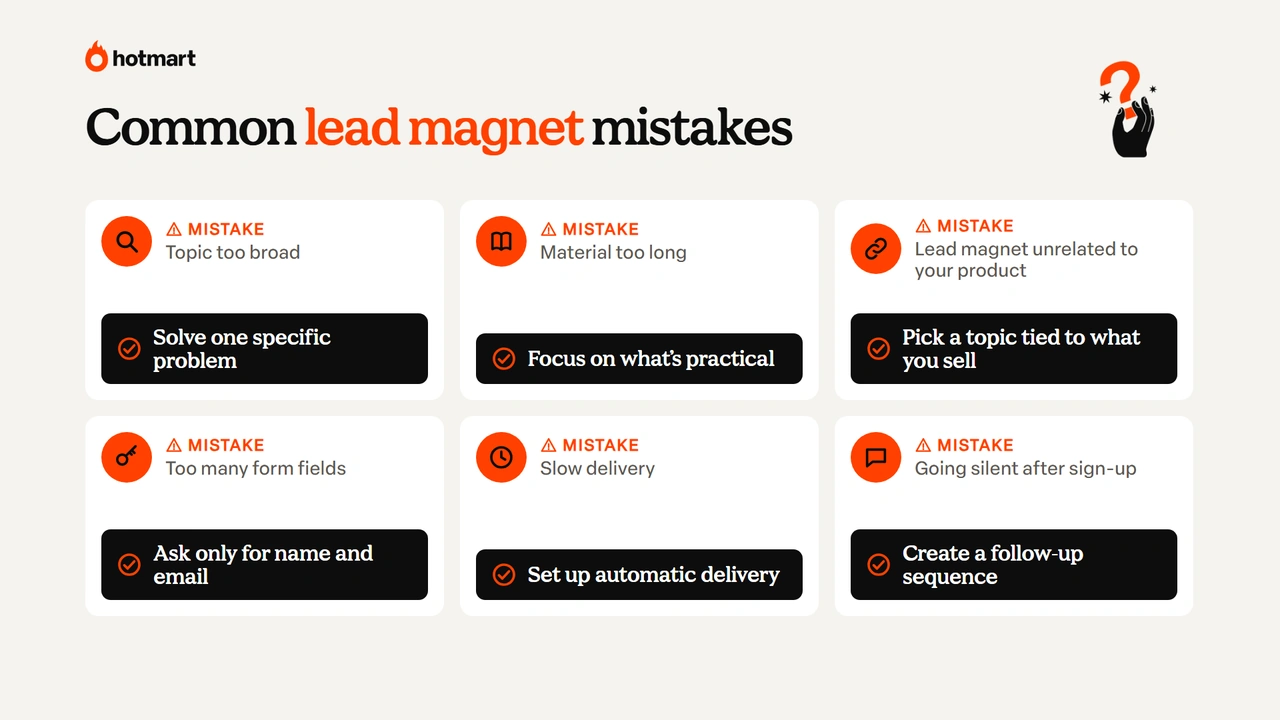
Here’s what to avoid:
- Picking a topic that’s too broad: replace generic subjects with specific problems your material can solve.
- Creating long, hard-to-consume content: focus on practical information and cut anything that doesn’t help people reach the promised result.
- Offering a lead magnet unrelated to your paid product: choose topics connected to what you plan to sell later.
- Asking for too much information in the form: request only the data you need to deliver the content and build the relationship.
- Taking too long to deliver: set up automatic delivery and test the process before promoting the page.
- Going silent after sign-up: create a sequence of relevant messages to keep building the relationship with your leads.
Fixing these points improves the experience for people who sign up and makes your strategy more consistent over time.
Ready to create your lead magnet?
Now that you know what a lead magnet is, it’s easier to see how to turn audience interest into a relationship opportunity.
As you’ve seen, a lead magnet works as a value exchange: you offer free, relevant material, and people share their contact details to get it.
The secret isn’t choosing the most elaborate format, but solving one specific problem and creating a natural connection with the product you want to sell.
With Hotmart, you can use Hotmart Pages, Hotmart Send and Launchpad to build landing pages, organize contacts and develop your relationship strategy.
Why not start with a simple idea? Pick a frequent question from your audience, turn the answer into a useful resource and take the first step toward building your lead list.
Lead magnet FAQ
Still have questions? Below, we answer some of the most frequent questions about lead magnets.
What is the difference between a lead magnet and a freebie?
There is no difference in practice. Lead magnet, freebie and opt-in incentive are different names for the same strategy: offering a free resource or benefit in exchange for someone’s contact details.
What is the best type of lead magnet?
The best lead magnet is the one that solves a specific need for your audience and connects to the product you plan to sell. Checklists and templates work well for quick wins, while free lessons let you show your teaching method.
How much does it cost to create a lead magnet?
It depends on the format and the resources you use. A simple checklist or guide can be made with free tools, while professional videos, personalized assessments and interactive tools may require investment in production, technology and promotion.
How many fields should a lead magnet form have?
Ask only for the data your strategy needs. To start, name and email are usually enough. Longer forms can make sign-up harder, so test different setups and keep an eye on your conversion rate.
Do lead magnets work if you don’t have an audience yet?
Yes. Even without followers, you can promote your lead magnet with ads, partnerships with other creators and blog or video content that points to your landing page. In that case, the lead magnet helps you build your business’s first contact list.
How do you deliver a lead magnet automatically?
The most common way is to set up an automatic email or message right after sign-up, or to unlock access on a confirmation page. On Hotmart, you can also deliver the material in the Members Area.