Types of Characters: The 7 Main Types, Archetypes and How to Use Them
Learn the 7 main types of characters, the difference between flat, round, static and dynamic characters, the Hero's Journey archetypes and how to use them in your stories.

What will we see in this post

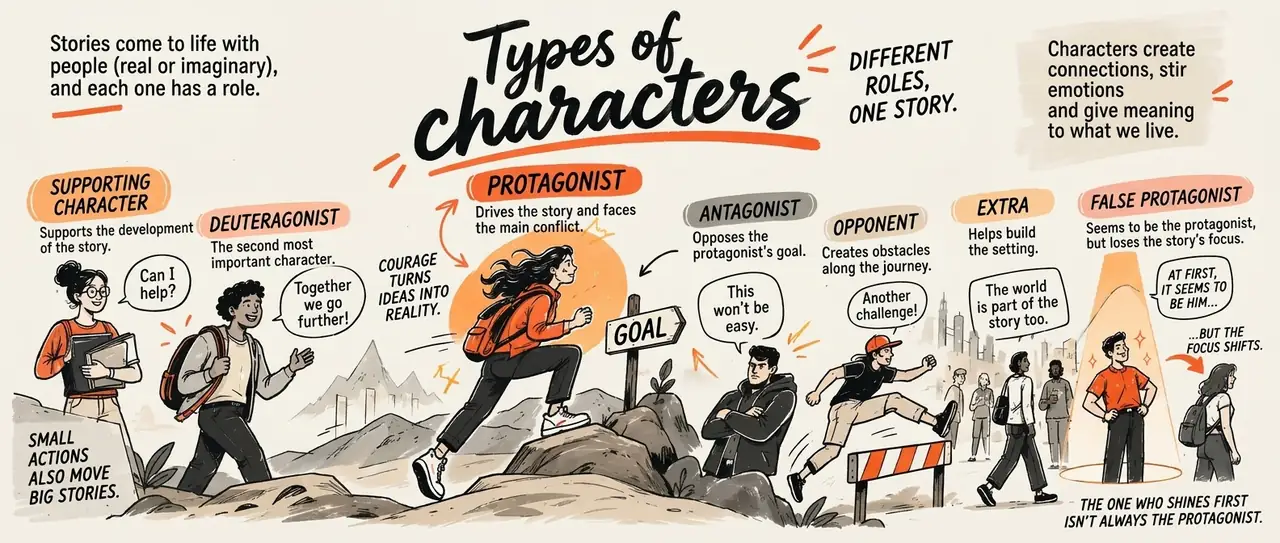
The main types of characters in a story are the protagonist, antagonist, deuteragonist, supporting character, opponent, extra and false protagonist. Each one plays a different role in the story and helps develop the conflict, the plot and the other characters.
But that is not the only way to classify characters. They can also be analyzed by their psychological complexity, as flat and round characters, and by how they change over the story, as static and dynamic characters. On top of that, ideas such as the hero, mentor, shadow and herald come up often when we talk about archetypes and the Hero’s Journey.
Understanding these differences helps writers, screenwriters and content creators build more coherent stories, create compelling conflict and choose characters who truly serve a purpose in the narrative.
What is a character?
A character is a figure who takes part in a story and plays a specific role in how it unfolds. A character can be a person, an animal, a creature, a fantasy being or even a personified entity, depending on the story’s world.
Characters can make decisions, face conflicts, influence events or simply help build the setting. That is why not every character needs the same depth or importance: the protagonist of a novel needs far more development than someone who appears in a single scene.
In Aspects of the Novel (1927), writer and critic E. M. Forster introduced a well-known distinction between flat and round characters. Flat characters are built around a few defining traits; round characters are more complex and can surprise the audience in a believable way. This is just one possible classification: we can also look at a character by their role or by how they change.
What are the main types of characters?
There is no single universal list of character types, because different theories use different criteria. If we focus mainly on the role a character plays in the story, the best-known types are:
| Type | Role in the story | Typical complexity | Example |
|---|---|---|---|
| Protagonist | Sits at the center of the conflict and the action | Often round and dynamic | Hamlet |
| False protagonist | Seems to be the main character before someone else takes over | Varies | Marion Crane in Psycho |
| Deuteragonist | Plays a major role alongside or in contrast to the protagonist | Often round | Sam in The Lord of the Rings |
| Antagonist | Represents a major force opposing the protagonist | Flat or round | Iago in Othello |
| Opponent | Creates opposition or obstacles at specific moments | Flat or round | A rival in a sports story |
| Supporting character | Moves the plot forward without being at its center | Flat or round | Dr. Watson in the Sherlock Holmes stories |
| Extra | Fills out scenes and settings without affecting the main conflict | Minimally developed | Passersby in a city scene |
The mentor, herald and threshold guardian can also appear as characters, but they are better understood as archetypal functions. That is why we cover them separately in the Hero’s Journey section.
The 7 most common types of characters: definitions and examples
The seven most common types of characters in stories are the protagonist, false protagonist, deuteragonist, antagonist, opponent, supporting character and extra. Here is what each one does:
1. Protagonist
The protagonist is the character at the center of the story or the main conflict, whose journey gets the most attention. They do not have to be heroic, admirable or morally good: a protagonist can be an antihero or even someone who would be the villain if the story were told from another point of view. So do not confuse protagonist with hero. Common traits include:
- Centrality: their journey is at the heart of the story.
- Goal: they want to achieve, avoid or change something.
- Conflict: they face internal or external obstacles.
- Development: they may change over the course of the story.
In marketing storytelling, a common strategy is to make the customer the protagonist. The brand does not need to be the hero: it can be the element that helps the customer move toward their goal.
2. False protagonist
A false protagonist is introduced as if they were the center of the story, only to lose that place to another character later. This device is used to surprise the audience. A famous example is Alfred Hitchcock’s Psycho: Marion Crane is the focus at the start of the film, leading viewers to believe they will follow her the whole way. For it to work, the shift has to be intentional; otherwise, it just looks like poor planning.
3. Deuteragonist
The deuteragonist is traditionally the second most important character after the protagonist. They can be an ally, a foil, a companion, a rival or have their own arc tied to the main story. Sam in The Lord of the Rings is a classic example because of his importance in Frodo’s journey. A deuteragonist also helps reveal the protagonist’s traits: the way the two agree, argue and face challenges shows things that would be hard to explain otherwise.
4. Antagonist
The antagonist is the character or force that strongly opposes the protagonist’s goals and helps set up the conflict. An antagonist does not have to be a villain. It can be:
- A person
- A group
- An institution
- Society
- Nature
- A situation
- An internal force within the protagonist
Picture a story about someone trying to survive alone in a freezing landscape: nature itself is the antagonistic force. In more complex stories, a good antagonist has their own goals, values and motivations, which makes the conflict more interesting.
5. Opponent
An opponent is someone or something that opposes the protagonist at a certain point in the story, without being the main antagonistic force. In a sports story, for example, the protagonist may face several rivals throughout a season: each is a specific obstacle, while the larger conflict might be self-doubt or the big final rival. Opponents help create different levels of conflict.
6. Supporting character
A supporting character plays a meaningful part in the story without being at its center. They can help the protagonist, create conflict, provide information or drive key events, as an ally, friend, family member, mentor, rival, love interest or travel companion. Supporting does not mean irrelevant: a good supporting character can have their own personality, goals and conflicts. The difference is their position relative to the main focus.
7. Extra
An extra is a character with a very small part, used mainly to fill out scenes and settings. Think of a restaurant scene: the servers, the diners at other tables and the people walking by help make the place feel real. Unlike a supporting character, an extra has no developed arc, but still adds context and believability to the story.
Hero’s Journey archetypes
Hero’s Journey archetypes are another way to classify characters, beyond their role in the plot. Joseph Campbell studied recurring patterns in myths and stories in The Hero with a Thousand Faces, first published in 1949, and Christopher Vogler later adapted those ideas for writers and screenwriters in The Writer’s Journey. The best-known archetypes are:
| Archetype | Function | Example |
|---|---|---|
| Hero | Faces challenges and goes on the journey | The character who accepts the central challenge |
| Mentor | Guides, teaches or provides resources | A teacher who prepares the hero |
| Herald | Signals or triggers change | A message or character that delivers the call |
| Threshold guardian | Tests the hero before a new stage | An adversary or obstacle to overcome |
| Shapeshifter | Creates doubt through change or uncertainty | A character whose intentions or loyalty are unclear |
| Shadow | Represents threat, opposition or what is repressed | A villain or force tied to the dark side of the conflict |
| Trickster | Stirs up change, often through humor | A character who breaks rules or exposes contradictions |
Keep in mind that an archetype and a character type are not the same thing. A character can play a role in the plot and, at the same time, take on one or more archetypes. A supporting character can serve as the mentor, an antagonist can embody the shadow and the protagonist often takes on the hero archetype.
How are characters classified?
Characters are classified by different criteria, such as their narrative role, their psychological complexity and how they change over the story. That is why one character can fit more than one classification: a protagonist can be a protagonist by role, round by complexity, dynamic by change and a hero by archetype, all at once.
Dimension 1: role in the story
This classification looks at the part a character plays in the plot (protagonist, antagonist, deuteragonist, supporting character, extra and false protagonist) and answers the question: what is this character’s job in the story?
Dimension 2: psychological complexity
This classification, made popular by E. M. Forster, separates flat and round characters:
| Type | Definition | Trait |
|---|---|---|
| Flat character | Built around a few defining traits | Simpler and easy to recognize |
| Round character | More complex, with varied traits | Can surprise without losing believability |
A flat character is not necessarily a bad character. In many stories, simple characters do their job perfectly well. The problem comes when the story calls for depth and the character lacks enough conflict or contradiction.
Dimension 3: change over the story
Another key classification separates static and dynamic characters:
| Type | Definition | How it is used |
|---|---|---|
| Static character | Keeps their core traits throughout the story | Serves as a reference point or contrast for other characters |
| Dynamic character | Goes through a meaningful transformation | Very common in stories built around character arcs |
A dynamic character’s change does not have to be positive: they may grow and overcome a fear, but they can also become more selfish or destructive. What defines them is that a meaningful transformation happens.
Dimension 4: relationship to reality and fiction
Characters also differ in how they relate to real people and events: they can be fictional, based on real people or historical figures portrayed in works of fiction. When a story involves real people, research reliable sources and be clear about how much creative license you are taking, especially in historical, biographical or documentary content.
What is the difference between flat, round, static and dynamic characters?
The difference is that these classifications look at different aspects of a character. Flat and round describe complexity; static and dynamic describe change over the story. So these categories are not opposites, and a character can be:
- Flat and static
- Flat and dynamic
- Round and static
- Round and dynamic
A very complex character can start and end the story without major change: they are round and static. Another can be fairly simple but go through a clear change: they are flat and dynamic. Understanding this helps you analyze and create characters more precisely.
How to use character types in practice
To use character types in practice, whether in videos, stories, online courses, campaigns or other content, these steps help. They are just as useful when you plan a video sales letter or a content series:
- Define your protagonist: who is at the center of the story, what they want and why that goal matters.
- Set up the central conflict before adding many supporting characters: the rest gain meaning from how they help, hinder or change the main journey.
- Decide how much depth each character needs: not everyone needs a detailed backstory, but central characters need well-developed motivations.
- Use archetypes as a guide, not a formula: they help structure roles without turning characters into stereotypes.
- Review each character’s role: if two characters do exactly the same job, consider whether you need both.
- Give them goals and motivations: characters are stronger when the audience understands what they want and what they will do to get it.
- Think about relationships: alliances, conflicts and differences reveal personality without long explanations.
In marketing, there is a particularly useful application: putting the customer at the center of the story. Instead of making your brand the protagonist, show your buyer persona facing a problem and present your product or expertise as something that helps them along the way.
How to create a great character
A great character needs a clear role in the story and traits that fit that role. For important characters, develop these elements:
- Goal: what do they want?
- Motivation: why do they want it?
- Conflict: what is stopping them?
- Fear: what are they afraid of losing or facing?
- Values: what do they believe in?
- Contradictions: what traits make them less predictable?
- Relationships: how do they act around other characters?
- Transformation: what might they learn, lose or change during the story?
Imagine two characters who want to start a business. One wants independence; the other wants to prove to their family that they can build something on their own. The external goal looks the same, but the motivations are different, so their conflicts and decisions can take completely different paths.
Checklist: is your cast ready?
To know whether your cast is ready, check that every character truly contributes to the story:
- Does the protagonist have a clear goal?
- Is there a meaningful conflict standing in the way?
- Is the main antagonistic force well defined?
- Do supporting characters have distinct roles?
- Do the most important characters have understandable motivations?
- Does each character’s depth match their importance?
- Is there transformation where the arc calls for it?
- Are archetypes guiding you rather than becoming stereotypes?
- Are there characters you could remove without changing the story?
If several answers are no, it is worth revisiting your cast before moving into production.
Use character types to tell better stories
Knowing the types of characters helps you understand why some figures sit at the center of a story while others create opposition, support, contrast or simply build the story’s world. In this guide, you saw the differences between protagonist, antagonist, deuteragonist, supporting character, opponent, extra and false protagonist, how characters can be flat or round, static or dynamic, and archetypes such as the hero, mentor and shadow. These ideas are just as useful for any content creator as they are for novelists.
For anyone who makes videos, courses or campaigns, these classifications are storytelling tools, not rigid formulas. Knowing them helps you choose who belongs in your story, what role they play and why your audience should care about their journey.
Frequently asked questions about types of characters
Still have questions about the types of characters and how to use them in your stories? Below, we answer the most common ones.
What are the main types of characters?
By narrative role, the main types of characters are the protagonist, antagonist, deuteragonist, supporting character, opponent, extra and false protagonist. There are also classifications by complexity (flat and round) and by change (static and dynamic).
What are the 4 types of characters?
A widely used classification includes the protagonist, the antagonist, supporting characters and extras. However, there is no single universal four-type system: narrative theory uses different classifications based on role, complexity and change.
What is the difference between a protagonist and an antagonist?
The protagonist is at the center of the story and pursues the goal tied to the main conflict, while the antagonist represents a force that opposes that goal. The antagonist does not have to be a villain: it can be an institution, society, nature or another force.
What is the difference between a flat and a round character?
A flat character is built around a few defining traits, while a round character is more complex and can surprise the audience in a believable way. This distinction became well known through the work of E. M. Forster.
What is the difference between a static and a dynamic character?
A static character keeps their core traits throughout the story, while a dynamic character goes through a meaningful transformation. That change can be positive or negative and affect their beliefs, behavior or values.